Roof size on tomcat 255?

YesBye

New member
Joined
Jul 26, 2025
Messages
10
Reaction score
2
Hi to all.
Does anyone have their T.C. 255 accessible to measure the size of the flat raised portion of the cabin roof between the handrails on the tomcat 255. And how much is lost due to radar arch? Trying to figure if and how to best do solar up there and was leaning towards glue down flex panels.

We don’t have our boat yet and scrambling to see if we should get Bellingham to put this on before we take delivery…. Which is very shortly. We’ve called off any installation right now due to my inexperience and can always revisit it later.

>>>>>>>Anything we should get done now at factory ie switch panel capacity etc to facilitate this later? <<<<<<

an Ordering Oversight on my behalf!!!

Rob
 
I would want some air circulation beneath the solar panels.
 
Thanks Bob,
I just saw someone premounted their glue downs on what sounded like chloroplast panels to keep them cool. Mounting rigid panels also gives chance for double sided panels. Don’t want to lose spot for tender transport up there either….

It’s feeling like a rabbit hole right now. I asked MWMI to hold off proceeding for now till I wrap my head around all this If I can understand it fairly quickly would get Bellingham to proceed which many said factory install is way to go but … confused on exactly what we should be asking for.
 
Hi Rob,

We have the next Tomcat to be built behind yours.. I was up at NMI last week for a factory tour and got the chance to look at your build and snap a few photos. Looks great, NMI does nice work. Cannot help you on the solar question, but since your deck hasn't been joined to the hull yet, as of last week, I was just going to throw out there to add a midship cleat on both sides. Both Dr. Bob and John from Cat-O-Mine recommended this fairy inexpensive upgrade and ii makes docking/controlling the boat so much easier. In speaking with Greg last week he mentioned after my TC, NMI will probably be making the midship cleat stanadard moving forward. Enjoy your new boat!!

Michael
 
Bob and John from Cat-O-Mine recommended this fairy inexpensive upgrade and ii makes docking/controlling the boat so much easier. In speaking with Greg last week he mentioned after my TC, NMI will probably be making the midship cleat stanadard moving forward. Enjoy your new boat!!
Hi Michael,
Thanks a bunch for that. No cleat mid cab was about the only thing about the TC that didnt sit well with me having to hang a bumper from the roof midship. I was going to ask for a custom cleat there but talked myself out of asking as I thought that would be a mold change to do it strong enough. I also thought with the narrow side deck it could be a tripping issue going up the side. I think you are correct though this would be a good add. Hey shoot me some of your pics you took of our boat!
 
Are you guys talking about adding a cleat at the aft end of the cabin? I considered adding a cleat forward, in line with the anchor cleat, finding the one near the captain seat adequately positioned and easy to reach from the windows, but I won’t argue with Bob and John, they have a lot more experience than I do. I also have fender hanger at the captain and adjacent window, they work quite well and allow to put your fender on from inside the cabin.
images.jpeg
Rob, if you still need the roof measurement, send me a PM with exactly what you need and I should be able to get those to you this afternoon.
 
I am a bit confused--doesn't the Tom Cat have a cleat just outside of the helm and navigator's side windows? I have used a folding down device for fenders and put an extra side cleat at the very aft of the cabin on the inside of the gunnel in the cocpit. I have put several jam cleats on the back surface of the aft cabin bulkhead--I take a line from the bow cleat and the cleat outside of the side windows. I have the rest of these lines, and a line from the cleat inside the cocpit, into coils on the back side of the cabin bulkhead inboard to have all of the lines available in hand along with stern line, which is coiled inside the cockpit combing. Thus one can step ashore with all lines to control the boat, using spring lines, from the first cleat on the dock to control the boat in difficult docking situations.

Unfortunately the majority of my photo album didn't transfer over from the old site. I had a number of photos there which appear to be lost. I had photos of some of these modifications.
 
Hi Rob!
Congrats on a great boat, you’re going to love it!

I can’t measure at post-op day #3 after major surgery; doctor’s orders no climbing around on the boat for six weeks. I plan to wait until the day after tomorrow for that. I’m a terrible patient.

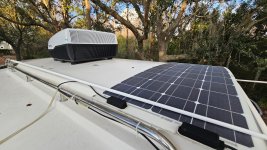
Anyhows, we glued down a Renogy 100 watt semi-flexible solar panel (the only one I could find that would fit) over Coroboard ‘plastic cardboard’ using Gorilla Glue structural adhesive about five years ago. It hasn’t come off yet, but it’s a 15 year old boat, and cosmetics aren’t as important to us now but would be more so on a brand new boat. I regard every interior roof penetration as a future potential leak, so led the cable over the eyebrow to enter the interior under there to the aft cabinet then inside the port gunnel panel to the house battery with a Blu Seas 15A breaker and a Victron MPPT controller. The panel was under $120 with free delivery from Home Depot. It overhangs tad on one side due to installer error. If this amateurish DIY approach leads to early panel heat failure, I’d just pry it off and slap on a replacement. Our perspective is that E0 marina gas in Canada is running $7/gallon, or $1,050 per fillup. We concur with Bob that 200 watts of solar is generally needed to replace the fridge plus other overnight loads. We got over 90% SOC per day replacement on a remote section of the lower Tombigbee over three full sunny summer gale days,but that of course is unusual. If you have a dog you’ll want a kayak that will shade a solar panel. There are big portable panels to cover a bimini that would hard to store and deploy.

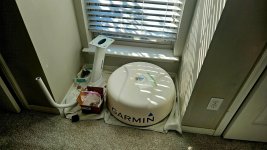
These boats have utilitarian systems, which is a feature, not a bug. Any local RV tech could mount your panel with much prettier results. That part of the roof is curved, not flat. An additional panel would be shaded under the 24 inch radar dome and mount and rooftop AC. Our only regret is that too much air flow from the Dometic AC is sent aft rather than towards the berth, but with 15K BTU and Dometic Smart Start board it cools pretty quickly. Other than where that 14” square hole is cut the factory default should be fine. Keep in mind you want to be able to remove the AC shroud to clean the coils and you’d likely have to remove the radar dome and mount to do that.

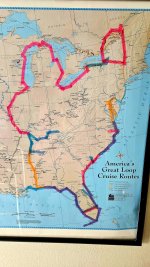
Another major factor to consider is to try to be able to get your air draft under eight feet, even if you have no current plans to do the Triangle Loop into Canada (the historic and free LaChine Canal goes right through downtown Montreal and avoids the horrid commercial Seaway Locks). It’s the top right red triangle on our Route to date; we plan to cruise it again this summer.
https://parks.canada.ca/lhn-nhs/qc/canallachine

Also, the vast majority of southern state and county road opening bridges have an 8 or 9 foot clearance that you can squeeze under without waiting an hour or two for an opening. We get to under 8 feet by removing the radar dome (4 bolts plus two quick disconnect cables). Removing a factory arch is another matter. Most Southern RR bridges are only 3-6 feet closed.

Agreeing with midship cleats both sides. We chose a big folding one on the starboard side after removing the blackwater Y valve that was in the way.

The big Blue Seas switches with pop-out breaker buttons take up a lot of panel real estate, esp if you prefer separate 12 inch displays for the Admiral as well as the captain. My approach is simply to protect small loads with a compact Blue Seas ATC fuse box (no switches, pull the fuse for ‘OFF’) under the helm for DC fans, Blue Seas digital helm voltage readout, hard-wired NEBO Gold box, stereo, AIS, Victron 702 monitor, etc etc.

It’s not a boat mod, but if you ever plan to cruise outside the US including Bahamas or Canada, there are advantages to obtaining an official Radiotelephone Operators and Station license and MMSI number from the FCC rather than a free one from BoatUS.

Don’t fret if it takes you and your crew a few years to figure out how you like to cruise. Over the years our priority has shifted to minimizing the time required to convert from Cruise Mode to Underway Mode and back. Your mileage will vary. PM or call with any questions we can help you with and welcome aboard!

Johnradar.jpgloop.jpgpanel.jpg
 
I am a bit confused--doesn't the Tom Cat have a cleat just outside of the helm and navigator's side windows? I have used a folding down device for fenders and put an extra side cleat at the very aft of the cabin on the inside of the gunnel in the cocpit. I have put several jam cleats on the back surface of the aft cabin bulkhead--I take a line from the bow cleat and the cleat outside of the side windows. I have the rest of these lines, and a line from the cleat inside the cocpit, into coils on the back side of the cabin bulkhead inboard to have all of the lines available in hand along with stern line, which is coiled inside the cockpit combing. Thus one can step ashore with all lines to control the boat, using spring lines, from the first cleat on the dock to control the boat in difficult docking situations.

Unfortunately the majority of my photo album didn't transfer over from the old site. I had a number of photos there which appear to be lost. I had photos of some of these modifications.
1774116429406.jpeg
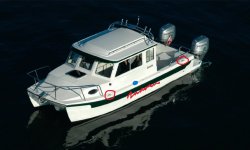
The current cleats are in the red circles. I think people were talking about one near the blue blob between the two. Currently If you want a bumper where the squiggly red lines are you either hang it from the roof rail or add hardware near the blue blob. Stock photo and all very very precise technical terms used blob squiggly etc. Rob.
 
Excellent post by John of "Cat o mine" and thanks to "YesBye" for a photo of current cleats position. I call the cleat on the foredeck the "bow cleat", the one on the side, the "amidships", although it is not really amid ships, and the furthest aft, the "stern cleat". I put the fold down fender tie poin in the "squiggle area", the next "amidship cleat" inside the gunnel/combing right by the aft cabin bulkhead.

I have one concern about "factory installations", in that they don't drill out, cut back core and fill with thickened epoy around where any pentrations in cored deck or hull are located. this includes forward opening hatch, radar arch, thru hulls etc. It takes more time and would cost more in the base price. There are some boats which have built in laminations of core material which is solid and never have any core issues. When we repaired my Caracal Cat, the cockpit floor needed to be removed to access the inner bulkheads in the amas. We put back solid blocks of fiberglass or similar material when we re-cored the deck (and used a rigig foam instead of balsa for the deck core.

One advantage of factory install in the boats with liners, is that more wiring and fittings can be hidden under the liner, and in unlined interiors, the wires are bundled at the time the other wires are pulled. I don't know how much customization is allowed in the basic boat. When I purchased my Tom Cat, I ordered a seconf water tank to the Port side. At the end of the build I was informed that they didn't want to put the extra water tank (or they forgot?), so they were just sending the tank loose on the bunk of the boat. Putting that tank in and running the hose/fill connections would take no more of an hour of labor time--which would of course be billed to the buyer. The water tanks were put on both the Port and Starboard side of the boats.

One other modification I added to all of my boats was a 18" to 24" grab rail across both sides to the forward end of the roof overhang, so there was a place to grab before you got to the hand rail near the raised cabin house, and a hand rail on the overhang part of cabin roof, unless there was a radar arch leg near there, so there was an easy hand hold comming out of the cocpit and transfering to the side deck to go forward or if crossing from one side to the other on the fore deck.

The other issue with solar panels was mentoined, and that was the dinghy placement for carrying, or kayaks, SUPaddle boards etc. Several boats solved that issue by putting the dinghy (or solar panels) over the cockpit--and making the Bimini a perminant structure, not the folding bows which most of us have. Some boats ever made that roof cantilevered, and plastic or other material than cloth covered. Some of the cantileavered tobs were made here in Pensacola. Blue Coral towers is an outstanding fabricator, and the only one I would use in this area, but they wanted $10,000 for the cantileavered frame without a covering. If I was buying a new Tom Cat, I might consider such an aft cockpit cover. Problem might be trailering--have to be very tighly laced to avoid any tearing when trailering at highway speeds.
 
On the solar panels: I would urge you look at the flexible solar panels and attach them to the corrugated plastic for cooling. I attached mine using 3M VHB tape and then taped the front and back edges with butyl rubber RV repair tape. This allows for smooth airflow when trailering. The corrugation were placed AT 90 degrees to the long axis to allow for the best cooling.

The solid panels with glass have two major issues as I see it: 1) they weigh a lot and can raise the center of gravity of the boat significantly that may make the ride in choppy waters uncomfortable. 2) trailering at highway speeds can exert an significant upward force and reduce gas mileage.

I would also suggest you look into the newer CIGS panels. These have a higher efficiency when the sun is not directly overhead, or if the panel is shaded in some parts (like a radar arch). If only a part of a regular panel is shaded the output from the panel will only be as high as if the entire panel were shaded. The CIGS panels have shunting diodes in each section so unshaded sections will still produce at their maximum.

Also, be sure to use a charge controller that is MPPT rather than PWM. There is a difference in their overall efficiency, especially in low light.
 
Wow. Thanks so much John on the Awesome Intel. And get well before crawling around on anything. I know the Lachine area near Montreal, its beautiful. That whole area in the fall is spectacular. Enjoy that trip!!!

We are at the last stages of the build and are trying to make sure any last minute changes could save having to do mods and rework grief later are done now just prior to shipping. NWMI has been great at incorporating many C-Brats insights into their new boat designs so I may be overthinking it.

Your comment on the electrical panel space, though...is it worth going one size larger on the switchpanels busbars at this stage or do you think with the compact breakers it would be ok? It would be nice to not have to pull out perfectly new or 1 year old panels. A few spare slots would be nice.

If its safe what do people think about having lithium house battery(s) off the transom up in/under the cab?. With the lower weight of lithiums it may be overthinking it as well though?

The more I learn the more questions I have. The goal is to avoid any big changes that could be solved at NWMI before shipping. Also trying to be cognisant of staying out of the way of NWMI and letting them finish her up :)
NWMI has been great at incorporating many C-Brats insights into their new boat designs so I may be overthinking it.

Your comment on the electrical panel space, though...is it worth going one size larger on the switchpanels busbars at this stage or do you think with the compact breakers it would be ok? It would be nice to not have to pull out perfectly new or 1 year old panels. A few spare slots would be nice.

If its safe what do people think about having lithium house battery(s) off the transom up in/under the cab?. With the lower weight of lithiums it may be overthinking it as well though?

The more I learn the more questions I have. The goal is to avoid any big changes that could be solved at NWMI before shipping. Also trying to be cognisant of staying out of the way of NWMI and letting them finish her up :)

Rob
 
I have ended up adding extra switch pannels to every C dory I have owned. I am even adding 5 more to my Caracal Cat currently. If there is a way for factory to put a larger panel in--go for it. I also often put that extra panel so I can access it from bunk from the 22 and 25; would be hard to do on the Tom Cat 255.

LiFePO4 batteries (the only kind of Li to have on a boat) are best placed inside the boat. On my TC 255, the extra AGM batteries were shoe horned inside the boat. The Li have more options because they are much lighter. Also you need large cables from the Li battery to the inverter. You do not want the inverter in the cockpit area. With things like this where the factory has probably not done any previously, you will probably be better off having a nearby electrical shop do the installation of the batteries and the inverter. I would only use a Victron or Mastervolt inverter. I used the Victron Energy MultiPlus 12/2000/80-50 120V VE.Bus (UL) (inverter), 80(battery charger from Mains 120 V or generator power, 50 amps boost if dock power is not sufficient. Also the remote and or monitoring system displays have to be mounted in a place easily visible. In my last 25, I had a monitoring system for the Li bank, and a separate monitoring system for the FLA house and starting batteries. I also had the DC to DC converter/charger for the LI from the engine. My batteries were about 2 feet from the inverter. The closer, the the smaller the cables. Also the Mains power AC panel has to be modified: the water heater, battery charger, and other resistive loads are not run thru the inverter (I put in a smaller instant water heater, and ran it off the inverter) This inverter can be placed under the galley counter with minimal effect on the storage, which gives almost instant hot water in both the head (shower) and the galley. By removing the hot water heater you free up a lot of storage space. To my knowledge the factory never has done this. As good as this manufacturer of the C Dory is, they still do not address the core problem of potential water intrustion by sealing any core penetration. It would make the boat more expensive, so the owner ends up having to make the repair, and then do the core isoation properly with epoxy potting and sealing of the core.

Here are a few "extras" I put in boats which I wanted separate switch: freezer and refrigerator separate, red night lights in cabin and cockpit. docking or fish landing white light forward and white light aft, sterio including Sirus, interior fans, white lights in ther cabinet storage areas, bait well pump, extra bilge pump and multiple fans: bunk, helm, navigator, & head.

Are you putting AIS transciever aboard? I would recommend one, and get the FCC MMSI number which is legal internationally (also makes your VHF legal in foreign waters. This comes from FCC, rather than the cheaper and quicker way from Boat US. While you are at it, join Boat US and the MMSI number is free to members if you only are planing to run the boat in US. Tow Boat US no longer assigns the numbers. Few of the PNW vessels do this for Canada, but in Mexico and Bahamas it should be the official MMSI number. Get a "master builder's certificate" if you may ever consider documenting your Tom Cat. (Yes a C Dory 25 and Tom Cat can be documented, and none of those pesky state numbers on the boat--only boat's name and hailing port of registration).
 
Last edited:
Hi Bob,
Thanks for all the info on electrical. Yes we put an AIS. I will definitely register the radio stations as we hope to go to Fri Harbor etc. for the meetups. I googled the master builder's certificate but couldnt find what you were referencing. Do you have a link.
Transport Canada showed over 6000 hits on that phrase. (their search engine sucks a person is supposed to sift through 6000 hits i guess.) Its possible we still need our provincial reg numbers here in Canada, but name only would be nice, a clean hull is a happy hull!
 
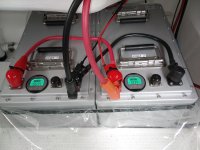
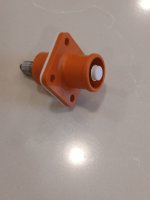
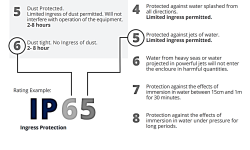
There are options for putting the Li batteries anywhere you want to if you make sure your batteries have a waterproof rating of IP 66 or higher. Unfortunately most Li batteries are rated only to IP65. The other thing you will need is a different connections to the battery (no lugs). I would suggest Amphenol powerlock connectors like the ones they put on e-propulsion batteries (these are waterproof). They come in different sizes and shapes. I have placed my Li batteries (IP66) in the space for the fuel tanks on my 22' cruiser and converted the power connectors to the Amphenol ones.

1774210106030.jpeg1774210557270.jpeg1774210771218.png
 
"DEPARTMENT OF HOMELAND SECURITY OMB No: 1625-0027
U.S. Coast Guard Expires: 04/30/2023
BUILDER’S CERTIFICATION AND FIRST TRANSFER OF TITLE".

This forum in USA is the Master Builder's certificate. I have documented boats I have built, and always filled out one of these forums. If you were documenting the vessel in the USA that would be the necessary form.

In Canada there is the equivalent: https://tc.canada.ca/en/marine-transportation/vessel-licensing-registration, This is avaiable for small vessels I believe. The major advantage of the US documentation is that foreign port officials recognize the "documentation" and it makes the process of clearing in and out of ports easier than dealing with state registrations. West Coast of Mexico this is usually not an issue. But when you get to Centra America, including Panama, it speeds the process or checking in and out. There was a rumor that the US could take over your vessel in war time, or would send the US Marines to your rescue--neither of these is true currently.
 
Thanks again Bob.
With the dory being new, we should have NWMI as the certified builder?, our Canadian up-fitter / dealer is doing the first Canadian Registration for us BC. I got confused when you said documenting, same as what I was thinking of as liscencing. I will go over the info you linked.


If we dont leave Canada its a bit more lax. But we intend to go over to WA so we will have to have all the i's dotted and tees crossed.

We will have MMSI for the AIS and Eprib as soon as we get hour HIN and Bill of Sale / title., Have an MI currently for the handheld VHF. We will get a station license for the Dash Vhf and AIS.

I think its as good idea up here even if not required, and we are required for all of that nowadays even for just heading to Fri Harbor or Puget Seattle area, just safer, and apparently the fines are big for the scofflaws.
 
Last edited:
Back
Top