Upgrading AGM to LiFeP04 house batteries - Advice?

CC Rider

Member
Joined
Nov 18, 2013
Messages
170
Reaction score
1
C Dory Year
2006
C Dory Model
23 Venture
Hull Identification Number
GXK23015K606
Vessel Name
CC Rider
I am looking for advice and product recommendations for changing out my current AGM house battery bank to a LiFeP04 bank. Also thinking of adding a solar panel or 2 for the house bank in the near future. (200W or so..)
I usually carry a Honda 1000i for charging the current system when on the hook for more than a day or two...

My current system consists of:
(2) Group 31 NorthStar NSB-AGM31M batteries which are almost 10 years old and have served me well, but are noticeably degrading in capacity. These are mounted under the V berth.

(1) Mastervolt Chargemaster 12/25/3 triple bank charger to charge the house bank, the starter battery (FLA) for my 2006 Yamaha F115 main, and a starter battery (FLA) for a Yamaha 8 hp kicker.

(1) Blue Sea SI-ACR automatic charging relay used between the house and main engine start battery

(1) Victron 702 battery monitor with the shunt currently connected to the house bank and the second input to monitor the voltage of the main start battery.

I am looking at purchasing (2) LiTime 140 AH Group 31 batteries to replace the AGM's under the V berth. This would not only increase the capacity of the house bank, but also save a bunch of weight in the bow of the boat.

I am thinking of buying a dedicated LiFeP04 charger (possibly a Li-Time 40A), disconnecting the current connection from the Mastervolt and only using the Mastervolt for the 2 FLA independent engine start batteries. The new LiFeP04 charger would charge both new batteries that are of course wired in parallel.

I will need charging for the new bank from the Yamaha 115, so a DC to DC charger is going to be required. Some of these apparently have solar inputs as well, so looking into the future solar panel setup, buying one of these units would save buying a separate MPPT solar controller... It is also my understanding that some of these units will serve the purpose of the Blue Sea SI-ACR by not pulling power from the main battery unless the motor is running. I believe the Yamaha only has a 35A alternator.

With the upgrade, should I remove the Victron shunt from the house bank (since the LFP batteries have bluetooth connection for monitoring) and connect it to the main start battery to monitor it?

I don't have an inverter, and don't plan on running one.

Any suggestions would be welcome!

Chris
 
Just a thought, could you use the same battery for main and kicker? Could be wire to a 1-2-both switch to keep them isolated from each other, that will save a litter bit of weight and expense.
I did that conversion last year with LiTime 100AH (X2) charge with a Victron Tr Smart 12-12-18, work perfect for me and look to be about the right size for your 35A charger but they do not have any solar input, the newer 50A might and is adjustable, the 18A and 30A are not. The LiTime APP on the phone is nice but I’m not sure if it is as accurate as a good shunt, it is not much of an issue for me since I don’t draw a lot of power at anchor and have not taken it below 50% last year. So a little inaccuracy will not affect me much.
Yes, the DC to DC charger will replace the ACR
I’ll let others with more knowledge then I have answer your remaining questions.
 
You could use a single ~300Ah battery instead of dual batteries. Lithium batteries are not meant for starting engines (although there are some that claim that they can). Boat motor alternators may not be able to support the current load of charging Li batteries without some sort of intermedary device (DC-DC charger).
I would have a Li battery for the house. A FLA or AGM battery for starting. A DC-DC charger to charge the Li battery. Setting up a system like this will probably require rewiring your boat (this is the reason I haven't done it yet), but I have done this setup in a van.
If you add solar you need an MPPT charge controller. You can get one that will also charge your starter battery after the house battery is fully charged. Renogy makes a charge controller that does solar and DC-DC charging.
WattCycle "dumb" batteries are more highly rated than LiTime batteries.

Search for Will Prowse on YouTube for lots of information and reviews of Li batteries.
 
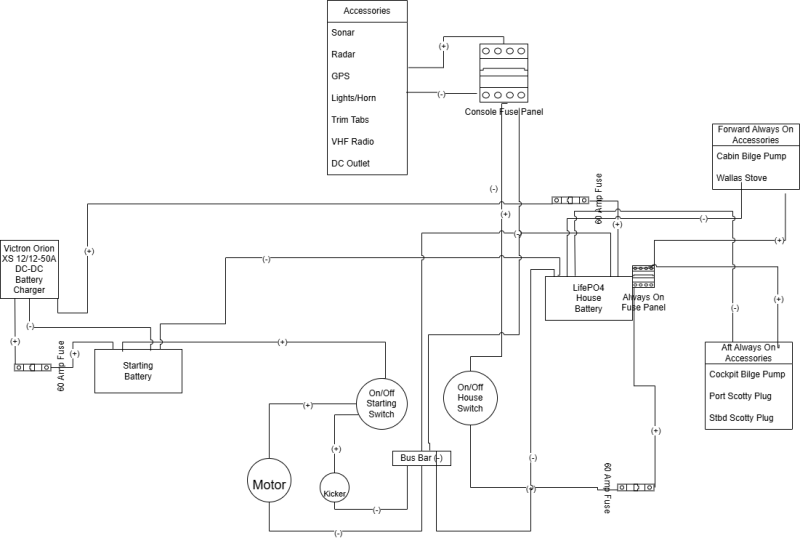
I am using the Victron Orion XS DC-to-DC charger, which is substantially lighter and smaller than their older options. Here's a rough diagram of my setup with a single LiTime 100Ah Bluetooth battery.

full


I mostly fish and do not run too many always-on electronics (no fridge/freezer). LED cabin and anchor/nav lights. The lithium battery is rarely under 97% full during day use while motoring/trolling, and I've gone out on a few 1-2 night trips without running out of juice. I have not needed to plug into shore power over the past year, but I carry a Victron charger just-in-case. The motor has kept the batteries topped off otherwise.

I thought about solar but have not found the need for it yet. It might be worth investing in if you're on extended cruises on the hook or have more always-on devices. I believe the general recommendation is to have a separate MPPT controller for each panel, so you might take that into consideration when evaluating the all-in-one charger/controller vs. separate unit options.
 
Just a thought, could you use the same battery for main and kicker? Could be wire to a 1-2-both switch to keep them isolated from each other, that will save a litter bit of weight and expense.
I did that conversion last year with LiTime 100AH (X2) charge with a Victron Tr Smart 12-12-18, work perfect for me and look to be about the right size for your 35A charger but they do not have any solar input, the newer 50A might and is adjustable, the 18A and 30A are not. The LiTime APP on the phone is nice but I’m not sure if it is as accurate as a good shunt, it is not much of an issue for me since I don’t draw a lot of power at anchor and have not taken it below 50% last year. So a little inaccuracy will not affect me much.
Yes, the DC to DC charger will replace the ACR
I’ll let others with more knowledge then I have answer your remaining questions.
Hi Stephan;
Thank you for the reply, while it would be nice to decrease the weight of the 2 FLA start batteries by using only a single one, I prefer to keep the 2 engine start batteries as separate systems. I power my downriggers and pot puller from the kicker's battery, and the kicker has electric start and power tilt.

I found a Renogy 40A DC to DC charger with MPPT on Amazon for $158 CDN which seems like a good deal. Unfortunately this unit will likely damage the Yamaha's 35A alternator. There is a Renogy 30A unit on Amazon for $ 260 CDN.....why this is more expensive is beyond me.. and may still overload the Yamaha.... not sure about this. I may just go with a standard non-MPPT DC to DC LiFeP04 charger in the 20A range and just buy a separate MPPT solar controller.

I need to keep the (2) Group 31 profile batteries idea, instead of a single larger unit because of the work already done under the V-berth to mount the old Group 31 AGM's

For shore power charging of the two 140 AH LiFeP04 batteries, is the advice to go as big as possible, say 60A or perhaps a 40A is wiser?

Thanks in advance,
Chris
 
Last edited:
I used the 80 amp battery charger on the Victron Multiplus 12 2000/80/50 as the shore battery charger. I prefered to use a user setable DC to DC charger: Sterling: max 30 amp DC to DC charger. The newer "Saturn" from Sterling comes with 6 preset profiles and one user setable profile.

On the single battery setup, I use the Orion by Victron--18 amp is plenty, for the single 100 amp hour battery I use in the portable car rig. No stress on alternator of car engine. I can see the use of solar panels on month long trips, where you often stayed in one place. For between uses, a 35 watt "trickle" charge solar panel is plenty to keep the start and house battery topped off. The outboard motor alternators kept the LI and FLA or AGM house batteries well charged if we were running every other day (your charge may very dependant on length of time the outboard is run.
 
When purchasing a LiFePO4 battery make sure it is listed as having GRADE A cells. If grade is not mentioned it probably is GRADE B. There are a lot of Chinese, inexpensive batteries that are Grade B.
Summary from Google:
  • Quality & Standards: Grade A cells are premium, meeting all manufacturing specifications with consistent performance. Grade B cells are often those that fail to meet strict A-grade standards due to slight variations in capacity, internal resistance, or physical defects, though they are not considered dangerous or "faulty"
  • Cycle Life: Grade A cells usually manage 3,000-5,000+ cycles, while Grade B cells typically handle around 1,000–1,500 cycles.
  • Safety: Grade A cells offer higher thermal runaway temperatures and better stability under high stress. Grade B cells, while still usable, possess a slightly higher risk of failure or instability under high-current conditions.
  • Cost: Grade B cells can cost significantly less (often half or less) than Grade A, making them attractive for smaller budgets.
Manufacturing Grading Process
  • Grade A (A-Grade): Fully meet technical specifications for capacity, voltage, thickness, and performance. They are typically for electric vehicles (EVs) and high-demand energy storage.
  • Grade B (B-Grade): Derived from the same production line but fail to meet the strict consistency of Grade A, often displaying higher internal resistance or slight capacity variances.
  • Yield Rates: Top manufacturers achieve over 95% A-grade yield, whereas lower-tier manufacturers may produce 5–10% B-grade cells.
 
I found a Renogy 40A DC to DC charger with MPPT on Amazon for $158 CDN which seems like a good deal. Unfortunately this unit will likely damage the Yamaha's 35A alternator. There is a Renogy 30A unit on Amazon for $ 260 CDN.....why this is more expensive is beyond me.. and may still overload the Yamaha.... not sure about this. I may just go with a standard non-MPPT DC to DC LiFeP04 charger in the 20A range and just buy a separate MPPT solar controller.
This the charger I am using in my van conversion. The charging current can be set to a lower value if your alternator can't handle sending 50A to the battery.

https://www.renogy.com/products/renogy-12v-24v-ip67-50a-dc-dc-battery-charger-with-mppt

Newer units have fancier features (like bluetooth or wifi) that increase the cost.
 
The capacity of your shore power charging will depend on your specific situation. I normally don’t have access to shore power until I’m back at home with the boat on its trailer, then I’ll have a few to several days to top off my batteries, a 5-10 amp hour charger is perfect for me. If you go out for several days with a rare night with shore power, then something bigger like the 80 AH that Bob mention will fit your needs better, or something in between.
As for the dc to dc charger, the rating on mine (and I’m expecting for most) is the output, meaning I get 18 amps at the house bank and probably drawing closer to 20 at the alternator. Just something to keep in mind if you get to close to your max rating.
 
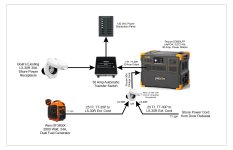
I decided instead of upgrading to Lithium batteries to just install a large power station. The 20 year old CruisAir AC unit was on its last legs so I yanked it out and started looking for something that would fit that locker. I found the 3kWh Pecron E3600LFP fits the locker perfectly.

This power station is really sophisticated. Total battery capacity is 3,072 Wh. One neat feature is you can charge it while using it. From shut off at 5% to 100% it charges in about 1.5 hours with 110 VAC at 30 Amps (3200 W) or about 2.25 hours with 110 VAC at 15 Amps (1800 W). Those are unbelievably fast charging times (which I have tested several times). My Wen generator maxes out at 24 Amps but the Pecron has user adjustable charging rates (in 10% increments) so I turned it down to 90% to accommodate my generator.

The Pecron’s AC Inverter is a whopping 3600 W continuous with a 7000 W surge (10ms) so it can run the whole boat. It also has a built-in UPS function. It has 16 outputs, multiple USB ports, and a 15 W wireless charger on top. It has Wi-Fi and Bluetooth app control if you like that or is fully controllable at the front panel. It also has options for battery expansion units if you want more capacity (up to 15kW). And here’s the kicker: it has a TT30R 30 Amp 110 VAC output for RVs or boats.

So I just took the TT30R 30 Amp 110 VAC output cord, and wired it along with the 30 Amp shore power inlet wiring, into a 30 Amp auto-transfer switch, then fed that to the 110 VAC distribution panel. And voila! I can run the entire boat while "AnchoredOut" … as if I was at the dock connected to shore power. But when I do come in to the dock it automatically switches over to shore power and I can charge the Pecron with the 110 VAC 1800 W cord from any 110 outlet in the boat in 2.5 hours. All this while not touching my two lead acid engine batteries (which I can charge with the Pecron using the C-Dory Guest charger if I flip the switch). And zero additional load on the outboard engine’s alternator and no major boat rewiring hoopla.

Anyway, super-simple system. I've tested everything and it works great. Hope to start the Great Loop in the next week or so. Still working through the launch punch list. So far I installed a 50 Amp wireless winch solenoid for the anchor (since I’m going solo I need to be on the bow sometimes while bringing in the anchor), 2 new Innovative Products hatches in the cockpit floor, tossed out the 20 year old Norcold fridge and the Seaward HW heater. Replaced with a Bodega 45 L fridge/freezer, and a Chinese knockoff of the 2.5 gallon Bosch HW heater. I also added a 5kWh Vevor diesel heater. When I did the Great Loop in 2021 I used the AC maybe twice the whole 10 months I was out, but I needed heat probably 15 or 20 times. You can get cool nights in the early spring or fall (anywhere except FL) and esp on the northern end of the Great Lakes at night. Frequently saw 50’s and a few times it dropped into the 40’s at night.

See attached schematic.
 

Attachments

  • C-Dory 25 Cruiser Electrical Upgrade.jpg
    C-Dory 25 Cruiser Electrical Upgrade.jpg
    164.2 KB · Views: 18
I have never been an advocate of the "Suitcase" battery/charger/inverter all in one units. Generally you can get a better unit for less money. But I do see the feature of being able to take this from the boat to the RV to the car for different intended uses. What I don't see in your diagram is charging this from your outboard/outboards. That is a vital function for keeping the house battery charged. You say the whole boat is run on the suitcase "generator". The other issue is charging your engine start batteries and heating water off of the inverter unit. I have to surmise that you really don't have a separate house battery, but use one of the engine start as a house--lights, instruments, etc. I don't know how your boat is rigged for cooking etc.

On the Loop, please give us a shout when you are in the Horme Port, Orange Beach, Wharf, Perdido Bay, Pensacola area--we are on the upper part of Perdido Bay, and most C Dory owners doing the loop stop by for resupply, R & R, a trip to the nearby NAS museum, or a tour of Florida, and some good Southern Cooking. I would look forward to seeing your boat.
 
Thanks for the hospitality! I do hope to stop in and say hello. I’m getting a late start so I am not sure if I’ll launch in Chattanooga or perhaps in Demopolis.

Technology is rapidly changing and these type units have become wildly popular. The Pecron has a 5 year warranty and good overall ratings. I also have an RV where I can use it too, and it will work well at home during power outages. For $700 you can buy an optional plug-and-play Pecron 3,840 Wh (320 Ah) LifePO4 battery to more than double the overall total battery capacity.

What I avoided: not having to spend hours designing and modifying the boat’s wiring, not adding a charging load to the outboard engine’s already weak alternator, not investing in an assortment of crimping tools, electrical lugs, heat shrink, batteries, inverters, battery isolators, DC-to-DC chargers, and many untold feet of thick (and expensive) gauge copper wiring.

I didn’t touch the C-Dory lead acid battery system. It already had two relatively new Group 24 Marine Deep Cycle batteries on a 1, 2, both switch. And so they both charge (as usual) from the outboard engine’s alternator while under way. They provide house 12vdc operation but the only loads they see are water pump, anchor light, cabin lights, and a 60 W fridge. The cabin lights are so darn bright I will rarely use them. I added 32 feet of low power 120VAC LED lights that run around the ceiling border for a much softer and more adjustable lighting.

Since the boat’s 120 VAC system will be supported by the Pecron while at anchor I can just flip the Guest battery charger switch on or off to enable it to charge the two C-Dory lead acid batteries while anchored. With the 1, 2, both switch I plan to keep one of the lead acid batteries dedicated for engine starting and the other one dedicated for 12vdc lights/fridge. Everything else will be powered from 120VAC when at anchor.
It takes 15 minutes to heat 2.5 gals water (1500 W) for a shower which consumes about 15% capacity from the power station. I also have a 1500 W induction cook top which has a fairly low duty cycle. The neat thing is it only takes about 1.5 hours with my gas generator to charge the power station. I will do that in the morning while cooking breakfast and cleaning up and have a full charge for later that night after
cruising all day.

Note: I am not affiliated with Pecron in any way. Just an end user.
 
Hi AnchoredOut,

For the same reasons, I bought a Pecron 3800 and accessory battery, which together should supply ALL our 120v needs for three nights or more, plus the existing but totally separate three Group 31 AGM batteries plus 100w Renogy glued’down panel has proven to be enough for three days and nights in the South on sunny days. Although we plan to divert mainly the fridge at night to the inverter rather than the AGM bank , it can run the 15k BTU AC (with Dometic Smart Start) or Caframo heater for several hours if needed. We tend to have a laundry date every 4th night at a marina and don’t need a generator. During the off season, it can be another home backup or for RV use. According to Jim’s review on the Forum, it automatically senses when 120V AC is present then passively allows it to pass through, so I’m not sure why you’d need an automatic Transfer Switch.

I’m not currently planning on changing ANY boat wiring until I’m sure it works out. I’ll just run the Smarplug cord from the boat inlet to the Pecron 30A outlet (with adapter) VOILA not one single wire cut, though it will look funny with the shorepower cord coming in an aft boat window. I’m sure that will be a dockside conversation starter.

Ditto Landing south of Huntsville has a good ramp, easy access to rig storage and a nearby airport should you need to fly back.

Did you have any issues with setting off the Reverse Polarity warning light on your AC panel when the Pecron is powering it?

Which direction are you heading, and why?

Safe travels!
John
 
Back
Top