Add steering to existing 9.9 kicker plus add electric for dinghy, or remove and use electric for both?

DaveInRI

Member
Joined
Aug 5, 2024
Messages
72
Reaction score
0
Location
Barrington, RI
C Dory Year
2005
C Dory Model
22 Cruiser
Hull Identification Number
CDO22275K405
Hi. I read enough posts about this subject to know such a decision will vary based on the individual, but wanted to ask if I’m being silly. Last summer I bought a 2005 22 cruiser which came with a 2019 Honda 90 and a similar vintage (haven’t actually checked the year to verify) Suzuki 9.9hp 4-stroke with its own onboard tank (gas cap on the motor; or hook-up an auxiliary) on a new adjustable bracket (Panther was the brand I think). I made sure to run it every few trips out and service it before winter, and test what it can and cannot do for me underway. I’d like to add a larger prop and one that’s 4-blade to get more torque, but even as-is it got the job done of moving the boat. The person I bought the boat from added this size for a “get home” motor due to concerns over health issues for his first mate— he wanted to get home every time, no chances. While I don’t presently have that concern, all of my boating is with my wife and two boys under 6 years old, so the ability to not just get out of harms way but get to a port seems a valid concern if they managed to get hurt. We boat in Rhode Island and near shore, with trips planned on the coast of Maine and some canals/rivers, so always near other people plus generally within vhf and cell coverage . We want to add a dinghy this season so we can always get to shore or a dinghy dock as we explore, and I plan to go electric outboard for that. Our trip duration will rarely exceed a long weekend due to work, and we aren’t planning to use it like the family car and travel around for miles like heavy dinghy users (or bringing laundry and groceries to shore while anchored 2 miles up river in a big sailboat on the other side of a bridge). Planing is always fun but I’d rather give that up for the simplicity of electric (like my snowblower and backpack leaf blower— I have the only snowblower on my street I can pick up easily and carry into the cellar… about 200lbs lighter than comparable gas models). So, the 9.9 motor is too heavy for my tolerance to move it onto a dinghy, back and forth. We also would be using the dinghy quite frequently, as every inch of coastline is developed and owned), more so than a davit to move the motor would add in convenience. So I’m buying the electric either way, as dinghy-first propulsion, and read on here that it would suffice under most conditions I’d be out in as a “get out of harms way” backup for the Honda 90. So I’d be annoyed having to keep the 100+ pounds of the Suzuki on the bracket, run it, service it, deal with fuel, etc., when I already have a backup (and have SeaTow as secondary backup). But, the boat came with the 9.9, which was attractive at the time, and it seems a waste to remove it with no purpose for it elsewhere. It works well, and 30lbs electric isnt that much weight to store elsewhere up front. I don’t have any other boats or plans for the 9.9 either, so I could try to sell it but don’t know if there’d be many takers at a price that wouldn’t also annoy me, ha. I’m also an “ultralight” focused person, when practical, and so the idea of removing 100+ pounds from the transom sounds very appealing. I’d rather not mess around with lithium house batteries just yet, but that’s also on my eventual to do list when there’s been a longer window of real world testing (both in impacts on the motors and in fires). Am I being silly to think about taking the 9.9 off and in its place storing the electric on the retractable mount until needing it for dinghy? (Which does help deal with shaft length issues since the mount goes down quite low) Or should I just double down on the 9.9, be glad it was a great deal, get a better suited prop for moving the 22, and link it up to the steering on the Honda so I can run/steer it from inside the pilothouse? These are the concerns of someone with 18” of snow on the ground, and not pressing, but I don’t know what I’ll do when it warms up. Are there use cases for running the 9.9 instead of the 90? I don’t fish, but I do like to putt-putt along at displacement speeds, and it seems the smaller motor (with larger and 4-blade prop) would be well suited for that, but I don’t have an idea of fuel economy. My Honda has a fitting that lets me disconnect from the fuel tanks and bypass to an auxiliary tank, so I can just run the kicker on that (keeping it’s on board tank empty), always ensuring stabilized and fresh fuel— I used to use TrueFuel on my daysailer 5hp because the tiny Honda jets would clog if not run for a week or run dry beforehand). If I wasn’t planning on using the dinghy very often, I’d go the davit route and have a planing dinghy, but it seems like too much work for weekend runs and frequent mooring stays, compared to the electric clamp on and go, then charge at home (solar is also on the to do list).

Thank you for any swaying insight or anecdotes.
 
I added a 6HP to my 22 cruiser and I was happy with it. I did use it quite a bit for slow cruising. On calm days I could easily go at 5 MPH, going against wave and stiff wind will slow me down to 2-3 MPH and struggle to keep a straight line if not going strait up wind, that something I was ok with. The 9.9 would be better but the raison I went with the 6HP was that I could transfer it to the dinghy without too much trouble, I don’t see anyone doing that with a 100+ pounds motor while being on the water, unless you have a davit, but that’s not common on a 22 ft boat.
9.9 HP 4 stroke with internal fuel tank are not very common nowadays I think, is yours a 2 stroke? I’m also curious to know the year model.
 
Well, much to my embarrassment, it seems my new-to-me C-Dory (got in August) has a 6 horsepower not a 9.9-- and I can't delete my post and slink back to the shadows.
 
You haven’t own your boat for long, if you only look at your kicker from the cockpit, while tilted up, really easy to confuse the 6 for a 9, no need to feel embarrassed.
 
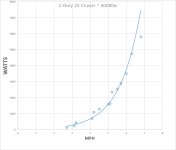
As somebody who cruises a 22' cruiser with only electric outboards I am a firm believer in electric. Before you make that decision however figure out at what speed you would like to move in emergencies and how you would deal with the battery. Some of the smaller e outboards have an internal battery while others need an external one. Below I have posted the graph of my power vs speed with my cruising weight at around 4000 lbs. That should help you figure out how much power in watts, you will need. Whatever you do, don't go by the horsepower ratings of the e-outboards; look at the fine print and determine what the maximum watts is for that motor. For example, 200 watts will get you 3mph but if you want to go 4 mph you will need about 750 watts. I cruise at 2000 watts (= 5.1 mph) with my two E-propulsion Navy 3.0 motors.

For example, the E-propulsion Elite uses 500 watts (about 3.5 mph for the C-dory) and has a special bracket that allows you to easily move from one transom to another. It has an internal battery and weighs about 18lbs. Epropulsion also make a 1 kW outboard (Spirit) that weighs 23 lbs but needs an external battery. Torqeedo also has a number of smaller outboards but I find them more expensive.
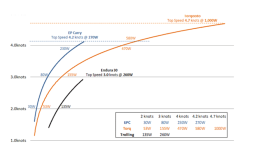
For myself I have just purchased an EP carry (280 watts and 14 lbs) as my emergency motor and one that will allow me to dock without having to be in the cabin steering the main motors. The EPcarry is designed and built by a friend of mine and he claims that his design is more efficient than a torqeedo or a trolling motor. The second graph is from his website, and I look forward to testing it out on my larger 22'.

1770582393265.jpeg1770583439857.png
 
I had used a equivilant of 3hp on my dinghys for about 15 years---they worked well there. They have parts that are no more than about 12#, so part by part (3 parts) were easily transfered to the dinghy. I also used this as the "get home or troling motor on my Caracal Cat. I also have used a Suzuki 2.5 hp gas motor--and is about the equivilant of the Torqeedo.

You will have a limited range pushing the larger boats, but dinghies will usually be what you need and then be charged back up when running each day. I have gone as much as 13 miles in the inflatabe using the Torqeedo. I would not count on more than 5 miles for a larger boat. When I have had a davit for putting a large dinghy on the top of a C Dory (22, 25 and Tom Cat 255, a very inexpensive foot and rail mout for that same davit easily puts in the bsck of the cockpit to lift freezers, heavy boxes of supplies, or an outboard motor from land, dock or dinghy to the back of the boat, transom, or cockpit.
 
As somebody who cruises a 22' cruiser with only electric outboards I am a firm believer in electric. Before you make that decision however figure out at what speed you would like to move in emergencies and how you would deal with the battery. Some of the smaller e outboards have an internal battery while others need an external one. Below I have posted the graph of my power vs speed with my cruising weight at around 4000 lbs. That should help you figure out how much power in watts, you will need. Whatever you do, don't go by the horsepower ratings of the e-outboards; look at the fine print and determine what the maximum watts is for that motor. For example, 200 watts will get you 3mph but if you want to go 4 mph you will need about 750 watts. I cruise at 2000 watts (= 5.1 mph) with my two E-propulsion Navy 3.0 motors.

For example, the E-propulsion Elite uses 500 watts (about 3.5 mph for the C-dory) and has a special bracket that allows you to easily move from one transom to another. It has an internal battery and weighs about 18lbs. Epropulsion also make a 1 kW outboard (Spirit) that weighs 23 lbs but needs an external battery. Torqeedo also has a number of smaller outboards but I find them more expensive.
For myself I have just purchased an EP carry (280 watts and 14 lbs) as my emergency motor and one that will allow me to dock without having to be in the cabin steering the main motors. The EPcarry is designed and built by a friend of mine and he claims that his design is more efficient than a torqeedo or a trolling motor. The second graph is from his website, and I look forward to testing it out on my larger 22'.

View attachment 129472View attachment 129473
Thanks for sharing this. I eagerly await the advancements in this technology which will hopefully allow for a reasonably efficient and speedy alternative to gas primary motors. Unfortunately for us, sailing speed of 5knots isn’t practical for the time we have available to go boating. We are 3 miles upriver from the saltier waters of Narragansett Bay in RI, so 6 round trip— each time out would be a commitment. I am, however, intrigued by the right to repair ecosystem of the EP Carry, as I generally like to be able to service things myself if need be, and the bigger brand systems are more a black box in that regard. What I don’t like about it, based on some videos, is the noise it makes compared to my alternative plan for a dinghy motor, the epropulsion eLite which is nearly fully quiet and a bit more polished in its appearance (eg, digital battery meter vs dongle to your phone; push buttons, etc). I wouldn’t want to rely on the elite as a backup motor for the 22, however, or at least I don’t think so. Looking forward to reading more the next few weeks. I’d trade the 6hp gas (that’s not a 9.9… oops) for a quiet electric and then would actually use it often for slow cruising, but then it’s a matter of weight again with batteries etc.. No free lunches as they say. I’ve looked into your electric cdory and have so many thoughts swirling— thank you for sharing to the forum your journey and experiments.
 
As somebody who cruises a 22' cruiser with only electric outboards I am a firm believer in electric. Before you make that decision however figure out at what speed you would like to move in emergencies and how you would deal with the battery. Some of the smaller e outboards have an internal battery while others need an external one. Below I have posted the graph of my power vs speed with my cruising weight at around 4000 lbs. That should help you figure out how much power in watts, you will need. Whatever you do, don't go by the horsepower ratings of the e-outboards; look at the fine print and determine what the maximum watts is for that motor. For example, 200 watts will get you 3mph but if you want to go 4 mph you will need about 750 watts. I cruise at 2000 watts (= 5.1 mph) with my two E-propulsion Navy 3.0 motors.

For example, the E-propulsion Elite uses 500 watts (about 3.5 mph for the C-dory) and has a special bracket that allows you to easily move from one transom to another. It has an internal battery and weighs about 18lbs. Epropulsion also make a 1 kW outboard (Spirit) that weighs 23 lbs but needs an external battery. Torqeedo also has a number of smaller outboards but I find them more expensive.
For myself I have just purchased an EP carry (280 watts and 14 lbs) as my emergency motor and one that will allow me to dock without having to be in the cabin steering the main motors. The EPcarry is designed and built by a friend of mine and he claims that his design is more efficient than a torqeedo or a trolling motor. The second graph is from his website, and I look forward to testing it out on my larger 22'.

View attachment 129472View attachment 129473

I think your setup is a way better trade off to this 20 kilowatt option on a smaller boat that only cruises at 6knots. Sure, top speed is 12, but that’s still like someone sprinting— not exactly “go fast boat” territory. And with a 20kw battery pack, to only get 11-45 nm range, just seems not worth it (to me at least, but I don't live on an all electric lake etc.). From what I’ve read elsewhere, hydrofoils are the key to unlocking electric go fast boats. (I’m not a go fast boat guy, but to only get 6 cruise out of 20kw is shocking to this layperson knowing what you are getting out of a pair of smaller ones).


They also just released for 2026 (learning this now; haven't been "following" them) a Spirit 2 after a solid decade-long run of their Torqueedo competitor, the Spirit 1. Poking around now-- it'll be interesting to see if it's a step or a jump ahead, and where pricing lands.

 
Last edited:
Comparison of Spirit 1 and Spirit 2 (starts at 3min 30 seconds):
(not endorsing the channel/person, just that he lists out the data for the two motors, which I couldn't easily find on the ePropulsion website so looked elsewhere)

Cost anticipated at $4200! No thank you!
 
"Wayne the boat guy" makes an excellent case for a motor he does not even mention: The Suzui 2.5 hp gas motor can be pruchased from $675. It weighs 31 Lbs, and pushes the boats I have used it on faster than the Torqeedo. I have to deal with items I have experience with. Note that "Wayne the boat guy" has a very light afbsolutly flat bottom narrow skiff--not even comperable to our dinghies of andy sort. I have compared the Torqeedo and the Suzuki on: C Dory 22, C C Dory 25 and Tom Cat 255, as well as mysterious Caracal Cat, an air floor 9 1/2' inflatable, and 6. and 8 foot Achelies fabric bottom tenders. The Suzuki 2.5 HP wins on all counts, except the Torqeedo has 3 parts so is easier to put on the bracket. The motors that "Wayne...." discusses are all heavier than the two I mention. Even when I was younger, 30# was often the amount I really felt comfortable transfering from C Dory to a dinghy--and best was the 3 partTorqeedo.

I might also mention the ferry boat at Honoon Isand state park:-certainy they wanted to be eco conscious, and had a boat run with electric motors. After years of problems, they were abandoned; these had large batter banks which charged overnight--since the boat was often in neary constant use during park hours--went back to gas outboards as being more reliable.

One of the motors "Wayne...." mentions uses a 70 lb battery pack--I don't know what type of battery they use, but that would be about 200 AMP hours in a 12 volt, LiFePO4 battery. These are redialy available, and I suspect at a much less price then their "factory" units.

Certainly we all have different ways we use our boats-and that has to be taken into account. Electric may be fine, if you are running mostly in protected waters, calm seas, no adverse currents for relatively short distances. There have been electric boats which have transited the Atlantic ocean--but their route was down wind, down current, taking a route with no adverse conditions. They have massive solar panels, and massive banks of lightweight batteries.
 
Bob, I would like to quibble with you a little. Electric cruising is more like sailing. You cannot compare it to cruising with big outboards. Speed is comparable to that of sailing, so one has to carefully plan routes based on tides and currents. I have been cruising Puget Sound, a semi-protected body of water with very strong tidal currents, [up to 9knots] for 29 years. In my first boat, a 24ft St. Pierre Dory, I only had a 1500 watt 36V fork lift motor, and it kept us cruising for 10 years, all be it at 4mph. I do not consider a range of 45 miles (at 5.1mph) as "short" nor 90 miles at 4mph. These are similar speeds to sailing.

Also, if you are interested in energy efficiency, electric is the way to go. From the data posted here folks get about 8m/gal of gas at 5 mph. That equates to 16 oz of gas per mile. If I convert the electrical energy I use (400Wh/mile at 5mph) to gas equivalent, I would be using only 1.5 oz gas to travel that mile. So, at 5mph gasoline is 1000% less efficient than electricity (10 x less efficient).
 
Yes, Tom, Electric power is very "effecient" as per use of energy and resources. However even in this post you bring out its limitations. I spent 4 years cruising the PNW from April thru October, going to SE Alaska in a Cal 46 sailboat. I have also spent two seasons cruising from Sequim to Icy Straits Alaska in a C Dory 22 and a C Dory 25. That would be almost impossible with your electric setup--especially since few nights are spent at marinas on my trips--where you are "marina bound" in order to recharge the batteries, unless you carry a generator, or massive amount of solar cells, and then your "electric boat" becomes a hybrid electric boat. Gas engines on the C Dory. generally give it a pratical range of 200 miles between fuel stops--it can be more by using lower speeds. How far. from your home base is the furthest you have gone in this 29 year history? You are happy with the same area for this peroid of time--fine. I like to explore the World. That is the beauty of the C Dory--you can explore places other boats cannot.

I have experience in other low power craft, having owned a 16' Glouster Gull rowing dory, which I rowed almost every morning 6 miles for a number of years (in S. Calif.). I have owned pure sail boats which are not really analagous, because you are unlimited with the wind--and even more dependent on currents.

The Cal 46 is a sailboat which powers at 8 knots and with a good breeze will sail at 8 knots and I have made 200 mile 24 hour "days" in both sail and power mode. We sailed the Cal 46 about 40,000 miles. I also cruised 40,000 miles plus in a 62 foot motor sailor--including a round trip from Calif to the Med, Baltic, and back. I have also cruised on other sailboats, most of the S. Pacific, New Zealand and Australia. So I am very aware of the effect of currents on low powered craft. I have crossed both the Atlantic and Pacific Oceans purely under sail--and averaging around 6 to 7 knots under sail. Although I have owned sailboats with zero power or a small outboard--my long distance cruising boats all had generators, and luxaries such as autopilots, watermakers, freezrers, and very sophisticated wind and navigation instruments, which systems needed a generator power to provide the 12 volts to keep batteries charged. My 62 footer had a range under power of over 3000 miles: From Panama to S. Calif non stop. A solar cell craft would have the range, but part of that is beating directly into the wind of an average of 20 knots and seas to match for hundreds of miles.

You make the point very well that your cruising range is very limited--90 miles before you are dead in the water, and no way to move the boat at that point. (Break out the paddles) How often did you make that 90 miles between recharges? Reading your various books and posts suggest that your usual crusing range was in the 20 to 40 miles under most circumstances--and definately affected by weather conditions, sea state and currents.
 
Back
Top