Grip tape

Ken O

Member
Joined
Mar 5, 2014
Messages
136
Reaction score
4
C Dory Year
1990
C Dory Model
22 Cruiser
Vessel Name
Ravens' Roost
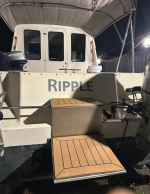
I want to add some grip tape to the molded fiberglass step inside the cockpit. I intended to paint it with traction paint, but I barely had enough for the floor. The fiberglass has a bit of a rough texture (but not rough enough to prevent slipping), which, in my experience, often results in a poor long-term bond for some grip tapes. Therefore, what is your favorite grip tape for surfaces that are not glassy-smooth?
 
I have found that no tape will work, in the long run, on textured surfaces in a boat in areas that are exposed to water. Water will eventually seep into the textured surfaces and loosen the glues used. There are several options I might suggest. 1) get a small can of paint and add "traction" material to it. You can get that at your local Home Depot or Lowe's. 2) Get a piece of rubber tread material or textured plastic flooring and attach it to the step with screws or double sided thick (1-2 mm) butyl rubber repair tape. This can be found in stores that cater to RV or roof repair (also Amazon). The soft rubber will fill the gaps in the molded texture and create a better bond with the tread material. Be aware however, that some plastics have plasticizers that will dissolved the butyl rubber over time. Soft PVC is the worst offender. Be sure to clean both surfaces with a good cleaner followed by a good wipe with isopropyl alcohol. The double sided butyl tape has been a standby in my toolbox for years. It is soft, conforms to odd shapes, and lasts. I have used it to attach everything from solar panels to wires.
 
We have used various paints and epxoies as the "binder" and anything from sand to ground walnut shells (used to clean jet engines) and various "grits"/anti slip addatives. (Put in "anti slip paint addatives" in your search engine). We put a coat of paint down after cleaning well, then while that paint is still "tacky", sprinkle the "Anti Slip addative" on the wet surface of the paint. Let this dry and put another or two other coats of paint over the first coat. We have used clear epoxy on teak and then the ground walnut shells, another coat of thin epoxy, and then top with some urethane clear "varnish" which has anti UV addative to protect the epoxy. Every few years another coat of the urethane keeps the step looking good. Think "KiwiGrip", this is a kit with special roller paint and addative.
 
I used Gaco Deck on my home outdoor balcony, and I suspect it is the same coating the Washington ferries use on their outdoor passenger decks. It would probably last 10+ years without a refresh for your use case. Like Bob mentioned, Gaco Deck uses crushed walnut shells for the texture but the coating is rubbery.

Finding a small quantity will be a challenge. I have a some leftover from my balcony job that I could possibly package and send you if it is not too dried out. Pewter gray color...and you'd need to source the texture.

Personally I would opt for gelcoat with a rough non-skid additive or a flexible non-skid mold. Test it out before applying to the boat.
 
An expansion of what Shad wrote: I have used gel coat of the same or contrasting color thicked to the point it gives small hills and valleys when applied with one the green rollers which looks like a coarse Scotch-brite Scouring pad. No non skid media is required. and the non-skid is not abrasive. Also not mentioned are micro glass beads as a non-skid addative. Quartz sand has "sharp" edges, the micro beads are rounded and not abrasive to foul weather gear or skin, yet give good traction underfoot.
 
Regarding painted nonskid, I've had good luck with interlux inter-grip nonskid additive, I used it on a swim step, and it provided secure grip while still being comfortable enough to sit on while wearing a bathing suit. It had more of a finely textured plastic and less of a sandpaper feel.

For a bonded non-skid,I just had some Navicork deck pads made for the swim-steps on my tomcat as well as a little spot on the rail where there is no molded in texture. This material seems to be more durable and dense than most hydroturf type foams, and less dense than some of the common synthetic teak alternatives. They were super friendly and happy to take on such a tiny project as they usually do whole decks. The pads were custom routed and shipped to me with all the adhesive needed to install. I haven't bonded them down yet but I'm excited to see how it works and also how it will hold up.

1767763228406.png
 
Back
Top