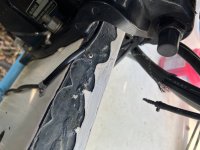
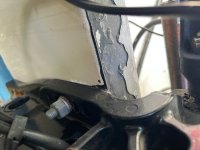
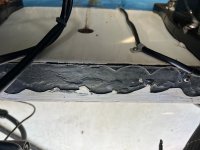
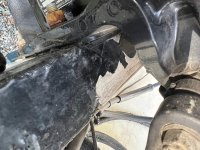
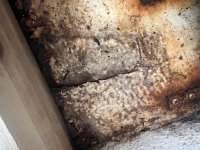
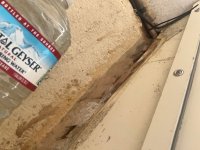
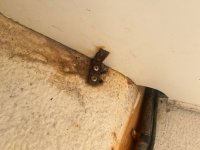
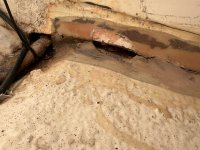
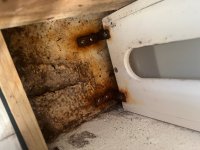
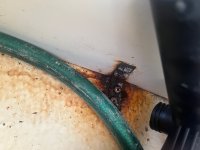
The "L" brackets were "zinc" or "Cadmium" coated stardard from the factory. This boat most likely has been in a high salt environment all of its life. I have approached these problems, but removing the "L" brackets, and putting a coupld of inches of fiberglass tabbing. I use mat which is compatable with epoxy resin, and cloth also compatable with epoxy. The binders in some glass cloth mat/woven and roving are soluable in polyester resin, but not epoxy. You want to repair these with epoxy resin because of considerably better adherence to the already cured polyester resin. The old glass tabbing (that which appears broken in #6504) should be all ground off, and down to some solid glass. I assume this is the bulkhead between the Cabin and cockpit by the hull. There is no real structural failure, but if it fully breaks down, then it would be an issue. I would replace all of the cockppit deck (floor) hatches, with water proof ones--there are a number of threads on this, and the proper IMETRA hatchs to use. Then all balsa is cut out, undercut around the hatch opening, and fill this will thickened epxoy. Any place there seems to be delamination, should be replaced. This is long term care/cure. I would do a bit more on the transom--over drill each of these openings, and then completey fill with thickened epoxy. Any place a screw penetrates the deck. should have a better core and the screw is biting into thickened epoxy. Try and keep penetrations in the transom to a minimum. The current outboard should be removed, and then the hole where the bolt was, undercut and filled with the thickened epoxy. Also put all of your weight on the lower unit, with outboard in trailering position. I also put extra roving and mat on the inside of the transom. The plywood core of the transom does not go out within a few inches of the transom and hull position.
I would use the boat this season and then spend a portion of the winter with the boat stored indoors, with climate control and area for a workshop. Take the floor out around the outside margins of the fuel tank. Pull the tank, clean it, and determine how much pitting is present. I would probably put a new tank in, unless there is basically no corrosion. Check the hull inner surface of the hull for intregrity of the core and delamination. Completly remove the tabbing of the aft cabin bulkhead on forward and aft sides, replace tabbing with two layers of mat and cloth or 1708 material. Pull all "L" and fill the screw hole (over drilled) with thickened epoxy. The put in 2" tabing where each of the "L" brackets were attatched--again sand down well. Check the rub rail for leaks, and replace any compromised fasteners. Check the V berth tabbing and the bulkhead between the main cabin and V berth cabin. Then you will have a solid boat for many years.
Any questions please ask and one ir more of the C brats will answer the questions and guide you through the repairs. Our boats are not more susceptible to blistering, core rot or delamination than any other boats. However our C Dorys have kept their value and in some cases appreciated in value. Unusual in the boationg world, and a testimony to how beloved and practical the boats are. I first saw a C Dory in 1982, and made a vow to buy one of these when I got too old and decrepit to sail. I honored that pledge in the early 2000 eras--and owned 5 C Dorys until I felt I could no longer care for the boats and cruise in them in my late 80's. I will be 90 in about a month.