New Solar

LuckeCatanias

Member
Joined
Apr 17, 2025
Messages
48
Reaction score
15
Location
Edmonds
C Dory Year
2005
C Dory Model
25 Cruiser
Hull Identification Number
CD025115D505
Vessel Name
Pearl
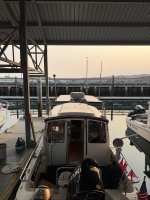
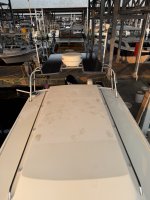
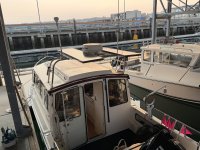
Finished installing a new solar array on my 2005 25 Cruiser.

The old panels sat directly on top of the house and the wiring went through the side of the house on the starboard side.
I didn't like this arrangement -- didn't work with a dinghy mounted on the house and the wiring going in through the side of the house wasn't my favorite.
I do really love having solar on the boat -- it makes living off the hook so much more enjoyable.

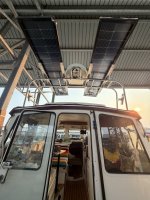
The new panels are a pair of 140W Bifacial panels (LS140WM1012V) from Lumera Solar.
They are mounted on my radar arch either side of the radar. This model is a "long and skinny" configuration to fit the space.
The fittings attached to the arch tubing are some aluminum billet motorcycle handlebar extenders from Amazon.
I supported the panels with some 6061-T6 aluminum channel extrusion.
Installed rivet nuts to allow minimum clearance installation -- I felt I needed to keep the installation below the scanning level of the radar.
All 316 SS upgraded fasteners throughout.
Galvanically isolated the entire support assy from the arch.
Installed all hardware with marine grease to reduce galvanic corrosion and prevent seizing.

I ran the wiring through the arch tubing after cutting in some new access holes.
New wiring has an abrasion resistant mesh sleeve with heat-shrink reinforcements at access holes plus rubber grommets to reduce/eliminate chafe.
I'll be re-mounting the solar controller to below the galley to eliminate all extra through holes from the old installation.


Overall I'm really happy with the look and final installation.
Interrupts the lines of the boat much less and clears up the top of the house for a dinghy.
Eliminating all visible wires is also very nice.

Please ignore the first photo which does not have the final connections made, I forgot to take a photo from this perspective at final installation.
IMG_3171.JPGIMG_3169.JPGIMG_3170.JPGIMG_3168.JPG
 
You seem to have a fairly good span of unsupported solar panel (towards the cockpit). Will the pounding that sometimes occcur with C-Dorys affect the life of the solar panels?
 
You seem to have a fairly good span of unsupported solar panel (towards the cockpit). Will the pounding that sometimes occcur with C-Dorys affect the life of the solar panels?
It looks longer than it is due to the fish-eye effect of the camera. It's only 21 inches of "unsupported" span. Unsupported is in quotes because the panel has it's own aluminum frame that provides a lot of support.

Here's my analytical approach to evaluating the effects here:

The weight of the panel that overhangs is about 4 lbs.
The most extreme pounding maneuver is certainly less than 4Gs which translates into 16 lbs overhanging.

When you do a beam calculation for the geometry of the aluminum frame which supports the panel at that magnitude of loading you get a maximum deflection of basically zero (calculated value of ~0.004").
In other words, the panel barely wiggles around even in a very high g maneuver.

Now, this is not commenting on fatigue loading of the panels, which is a real effect. However, given the small deflections shown in above, I don't think I'm subjecting the panel to anything unreasonable.

The proof, as always, will be in the lived experience.
If I get 5 years out of them I'll consider that success.
Solar panels are so inexpensive I'm perfectly happy to replace them at that interval.
The total cost for these including tax was under $400.
 
Have you towed this at nighway speeds? IF so was there any flex or potential issues with the unsupported panel foreward (I understand your good analysis of the back overhand, but the forces on these panels at 60 or 70 mph are a bit different than when even in 20 knots of breeze and 2 foot waves. Thanks. Good photos and installation.
 
Have you towed this at nighway speeds? IF so was there any flex or potential issues with the unsupported panel foreward (I understand your good analysis of the back overhand, but the forces on these panels at 60 or 70 mph are a bit different than when even in 20 knots of breeze and 2 foot waves. Thanks. Good photos and installation.
I don't trailer my boat so I don't need to think too much about it. But the fwd overhang is only like 11 inches. I don't think I'd be worried about the overhang aspect of this arrangement. Might want to think about the pull-through strength of the rivet nuts I have attached the panel frame with though at some point. It's definitely something to consider.
 
I also hope that you put in long alluminum bars (ie 1/8“X3/4“X4') as a backing plates to your bolts going through each side of the solar panel frame as these frames have become quite minimal even for static loads.
Good point.

I did not here.

I do have redundant attach points. I plan to regularly inspect these things especially after some hard rides. Again, the attachment here is achieved with aluminum rivet nuts. Assuming the pull-through of the nut is the critical load case, here's my approach to understanding how serious this is.

I confirmed with the MFG that the rails are 1mm wall extrusion (0.039 inches). The hole is something like 0.3710 diameter. Pull through would be the circumference of the hole times the thickness times the shear capacity of the material. Using that method, I end up a lot of capability at each fastener location. Over 1000 lbs.

That's a perfect world of course. I don't think the true capability is near that.
But it's a big enough number that I think I'm personally comfortable seeing how she goes.
I have plenty of zip ties on board for a reason I guess!

Also, IDK if I'd go right to large bars. Probably just a washer. That amount of shear area would likely move the failure of the installation to another mode.


If you've had failures in your securing of your own installation, I'd love to know details.
Real life failures are always more interesting.
 
Last edited:
Well, OK..., but I had large washers on mine and my HD cross bars were about 1/4 of the panel from each end and my panel wasn't as long or unsupported as yours by any means... I guess that there was more than 1000lbs of force on my 425w panel bolts and washers. Don't ask me how I know because being into overkill, I find this a bit embarrassing!... I now have a BougeRV, shade tolerant flex panel taped on the roof with 3M VHB tape and 5200 just around the perimeter. I'll probably have to change it out every 5 to 7 years, but not only is it WAY more secure, it looks much better too!
 
Last edited:
UPDATE --

TLDR; is 8 Ohms a dangerous resistance as measured from the negative bus at the helm to the negative bus in the transom?

I decided to do some checking on the wiring going from my solar controller to the house batteries as I was concerned with the gauge wire used for the run.

I keep a thermal camera on the boat for diagnosing such things and found that at the positive terminus my wiring was getting up to 100*F.
That by itself was not hugely concerning in terms of immediate safety but I decided that I would replace the run of what I think is 12awg with the recommended 10awg.

I then set about tracing the existing run where I found both through my efforts and archived posts from the previous owner here on C-Brats that the line used for the solar was scavenged from the abandoned circuit that used to feed the Wallis stove they had deleted.

I then became concerned not only with the gauge used, but the additional discovery that this meant that the negative run was quite long -- the abandoned positive ran from just forward of the head on the starboard side then over to the port side of the transom where the house batteries sit while the negative run went forward from the forward side of the head to the helm negative bus then along the main negative return back to the main negative bus on the starboard side in the transom.

I then decided to probe the resistance from my helm negative bus to the main bus in the transom where I found a reading of 7-8 Ohms.

Do folks find this reading concerning?
The highest draw item on this bus is now the fridge cooler which is rated at 7.0A @12V.

Do folks have any prior experience with similar and could share how the issue was addressed?
 
I would check the voltage drop across where you measured the 7-8 ohms. However, 7-8 ohms for a ground connection seems high to me. Get a similar length of whatever gauge wire is used for this ground wire and see what the resistance is. If this wire is also 7-8 ohms resistance, that is as low as you're going to get.
 
I would check the voltage drop across where you measured the 7-8 ohms. However, 7-8 ohms for a ground connection seems high to me. Get a similar length of whatever gauge wire is used for this ground wire and see what the resistance is. If this wire is also 7-8 ohms resistance, that is as low as you're going to get.
Good suggestion -- I did see that voltage drop is the preferred method of determining if there are issues along your wiring runs.

I put a load on the boat -- plugged in my fridge and every light I could and charging devices.
Disconnected from shore power.

Got a drop on the negative run from the locations I previously described of 0.25V.
Same run on the positive was higher at 0.30V.

Provided I was putting an adequate load on the system, that is within 3%.

7-8 ohms along a pristine length of 10 awg ~25 feet long is very small. About 0.3 Ohms.

So, I'm still scratching my head.


I'm now allowing that load to stand on the system for a while and I'll check for any hot spots with my thermal camera.
 
8 ohms is WAY too high for a wire connecting ground buses. 30 feet of 10 gauge wire should be about 0.03 ohms. I suspect you have bad connections/terminations.
 
Last edited:
8 ohms is WAY too high for a wire connecting ground buses. 30 feet of 10 gauge wire should be about 0.03 ohms. I suspect you have bad connections/terminations.
Thanks! That's a good thought.

I'll try refreshing all my lugs. Low hanging fruit at least and I'm sure the 21 y.o. oem ones are pretty thrashed as it is.
 
Back
Top