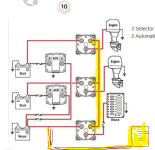
I have twin 150's on my boat. 25 amps each at cruise, 15 amps single at idle. With 2009 electrics/electronics (or severe lack of electronics I should say) I can see the want for twin starts and a house back in the olden days. With so many modern electronic solutions, I couldn't see any reason to keep twin starts and a house so here's what I did:
Starts: I removed one entirely and replaced the old one (still good) with a brand new of same capacity. This saved me 50 lbs off the back of the boat.
House: Removed the FLA and replaced with 100 amp hour lithium iron phosphate. This saved me another 25 lbs off the back of the boat. Plus you get RAPID charge and discharge rates.
To get this all to play, I installed a Blue Seas Dual Circuit Plus combiner and a Victron Orion 12/12-50 amp DC/DC charger. I've been running this set up hard for several years. No issues yet. I wouldn't do anything differently if I did it again. My house battery will flow 100 amps before the BMS turns it off. The DC/DC will pull max power from the alternators and charge up the lithium house. The max house charge is 70 amps so I'm not quite getting that but it works great. Don't let anyone tell you that you can't run outboard alternators at max capacity. That's something your granddad would have said about his 1975 two stroke with contact points. It's just simply not true anymore but the myth lives on.
Why my massive need for power? I run a 9 foot shaft 36 volt trolling motor 40 miles offshore in big ocean swells and currents. I run 3 electric reels literally nonstop for hours winching up big fish from 600-1,200 feet. The trolling motor runs on a 3 battery 65 amp hour bank that operates on its own combiner and shunt and circuits. I also just installed a 750 watt electric water heating element in my 6 gallon tank and a 1,200 watt/surge to 2,200 watt inverter that supplies the whole boat 120 grid with power.
I'm happy to answer any questions. I engineered and installed the entire system.
Rob in Tacoma