I have used ham radio aboard boats for over 40 years. The areas were from The S. Pacific, New Zealand/ Australia, the Med, the Baltic, the entire Caribbean, Mexico and Central America, to the Maine Canadian border, and from the top of the World Highway (via RV, but same rig and antennas) in Alaska. I have lost track of the modifiers used for my call sign. For the C Dory any one of the big three's all HF/UHF//VHF transcievers are good
. (Icom, Kenwood, and Yeasu) I have gone with 100 to 150 watts SSB output, but you can always dial it down when necessary and proper.
The ground plane is an issue. My best suggestion is to use 1 to 2" wide copper foil for the ground. I then have worked several different ways to the in the hull or in contact with the water grounds. I have used copper screen, soldered to the copper foil, and then a single layer of light deck fiberglass cloth bedded with epoxy to protect it. This should be as close to the radio as possible. I have also used Dynaplates or outside solid copper plates 1/4" thick and bonded directly to the hull. The copper foil is soldered to several bronze bolts which hold the plate in place. I have also tied the bow railing, and then run foil under one side of the boat above the hull to deck joint, inside the cabin and tied that in. All of these work well.
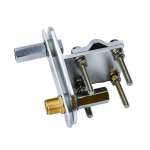
For Antennas, I have used the Ham Sticks for HF-SSB--now carried by MFJ. Select the bands you want. I would go with 75 m, 40m, 20 and 10m. I have used the
MFJ-347, mount on one of the hand rails, or the radar arch. There are plenty of base loaded VHF/UHF dual band antennas. Choose one which is all ss and the coil is well weather protected. I tried Hustlers way back, but there is a lot of pot metal in their construction and they will corrode. There are some all band, and I have forgotten the name of an Australian antenna which had plug ins coils at the bottom. (I felt danger of corrosion there)
The Port Ludlow Yacht Club runs the
Northwest Boaters net :
3.865 MHz (Lower Sideband) daily at
0830 Pacific Time (or 0900Z/1530 UTC depending on the season) This net tracks boaters from Calif. tothe Upper Alaska. (I have checked in from as far as Point Conception, CA to Icy Straits AK. I would definately suggest monitoring to start with. They have a limited PM net also. The propogation was not as good then, and I rarely used it. There are regulars who live on Vancouver Island, in the Mainland part of BC, and SE AK. There are a number of boating nets, aI nd I'll let you look that up, since times and frequencies change ofen.
I did have a 600 watt 12 volt linlear amp, but did not use it on the C Dory. You may want to get a manual MFJ tuner. If you are using the whips, most transcievers work fine with the "Ham Sticks". I did notice that there are "shark" antennas on Amazon, with the same frequency bands. I don't know anything about these. There is an antenna which has plug ins for base loading on different frequencies, and I believe is made in Australia, but the name escapes me. For CB you could use a separate whip, or use a 10 meter "ham Stick" and by moving the whip, get it tuned close enough for all of the CB channels. I like to keep my HF antannas at least 3 feet from the ship's VHF radio antenna.
I have done a number of experiments at sea with co-operative land based hams, to test various antennas. On our Cal 46 (which we cruised AK with) I had the Ham Sticks on a tri mount--3 bands on one mount. Which was about 10 feet off the deck on the rear radar arch. I had a shakesphere 23' Marine HF antennna base mounted and a stand off to the radar arch, an isolated back stay, and an all band dipole, either as an inverted V or sloper. I did find out that the boat's riging acted as a radiator. The best was the dipole, sloper. The "worse" was the insilated. back stay, with an auto tuner (SEA, with a SEA SSBHF 223, which had been modified to transmit on the ham bands. For the ham bands I used what is the equivalant of the Kenwood TS-850S HF. I had a MFJ manual tuner similar to the 948. I had switching for various antennas, and I could use the SEA autotuner or the manual MFJ tuner or straight to the selected antenna.
There are also a number of VHF/UHF repeaters, and I have used these a number of times. These come and go, but there are several good resources on the internet. I met some fantastic people on 2 meters via those repeaters. Our favorite Halibut recepie came from a 2 meter conversation and eventually an invite to dinner and the Halibut recipie.