
DaveInRI
Active member
- Joined
- Aug 5, 2024
- Messages
- 207
- Reaction score
- 33
- Location
- Narragansett Bay
- C Dory Year
- 2005
- C Dory Model
- 22 Cruiser
- Hull Identification Number
- CDO22275K405
- Vessel Name
- Once
I'm replacing my 6hp gas kicker with an EP Carry electric outboard, ordered just yestearday. This is basically a 270W highly efficient motor (motor/gear/prop/no seals = efficiency max), which matches a Torqueedo 603 in terms of propulsive power but using half the energy to do so, and with all the range you can choose to pay for.
My new-to-me 2005 22 Cruiser has 2005 electronics (VHF, Chartplotter, and fish/depth) which I'm replacing this spring. All 12V, and I don't want to run new wiring apart from the battery end and new electronics connectors, so I'll use a 12V lithium house battery. I'll keep the lead acid starter battery, but isolate it except for starting purposes-- the alternator will go to the house battery w/ an intermediary like an Orion in between to preserve battery and alternator. I'd then use a DC-DC connector to occasionally top-off the lead acid, if it needs it between trickle charges at home. The large 12V house battery will also have an MPPT that will be used to charge my EP Carry's portable dinghy battery when I get back to the CDory (it can also be charged at home). I am not addressing on-board inverters, solar, or shore power now, none of which are presently hooked-up or 2026 projects.
Does anyone see anything wrong with this? I'm going for 80/20 least in/most out in terms of weight savings and amp hours gained. I'd have off switches and fuses in the right requirements and locations.
Three batteries:
Charging:
Weight wise, I'm going from a 55lb Suzuki 6hp (excluding gas) to a 14lb EP Carry, so with cord call it 15, so net savings of 30lbs before battery. A 100Ah 12V lithium is around 25lbs quick math, so I'd only be saving 5 pounds overall with that, plus the loss of the house battery presently there, probably 35+ pounds, so call it a 40 pounds net savings off the stern. I'd then add a 6-15lb dinghy battery (TBD), call it 10lbs, so 30lbs net savings off the stern. Not a whole lot with these estimates, but it might be more in real life. But, I gain a lot more amp hours on the house battery and the ability to run the EP Carry all the time and have it charge by the Honda. My battery switch is broken anyway (can't turn it without pliers; seller gave me a set) so I need to mess around back there anyways, and update the electronics. So this is all a big improvement, but not a conversion or build-out. I just would like a second set of eyes to say "yep that would work fine" or "don't mix chemistries even with a DC/DC / forget a shunt / balancer / BMS" etc or you'll catch on fire etc.. I'm learning, but keenly aware I don't know what I don't know.
Thanks, All.
My new-to-me 2005 22 Cruiser has 2005 electronics (VHF, Chartplotter, and fish/depth) which I'm replacing this spring. All 12V, and I don't want to run new wiring apart from the battery end and new electronics connectors, so I'll use a 12V lithium house battery. I'll keep the lead acid starter battery, but isolate it except for starting purposes-- the alternator will go to the house battery w/ an intermediary like an Orion in between to preserve battery and alternator. I'd then use a DC-DC connector to occasionally top-off the lead acid, if it needs it between trickle charges at home. The large 12V house battery will also have an MPPT that will be used to charge my EP Carry's portable dinghy battery when I get back to the CDory (it can also be charged at home). I am not addressing on-board inverters, solar, or shore power now, none of which are presently hooked-up or 2026 projects.
Does anyone see anything wrong with this? I'm going for 80/20 least in/most out in terms of weight savings and amp hours gained. I'd have off switches and fuses in the right requirements and locations.
Three batteries:
- Lead acid starter — one job only, starts the Honda. Completely isolated from the alternator and from the rest of the system. Kept healthy via occasional top-up from the house bank and a trickle charger at the home dock/driveway. Cheap and tested.
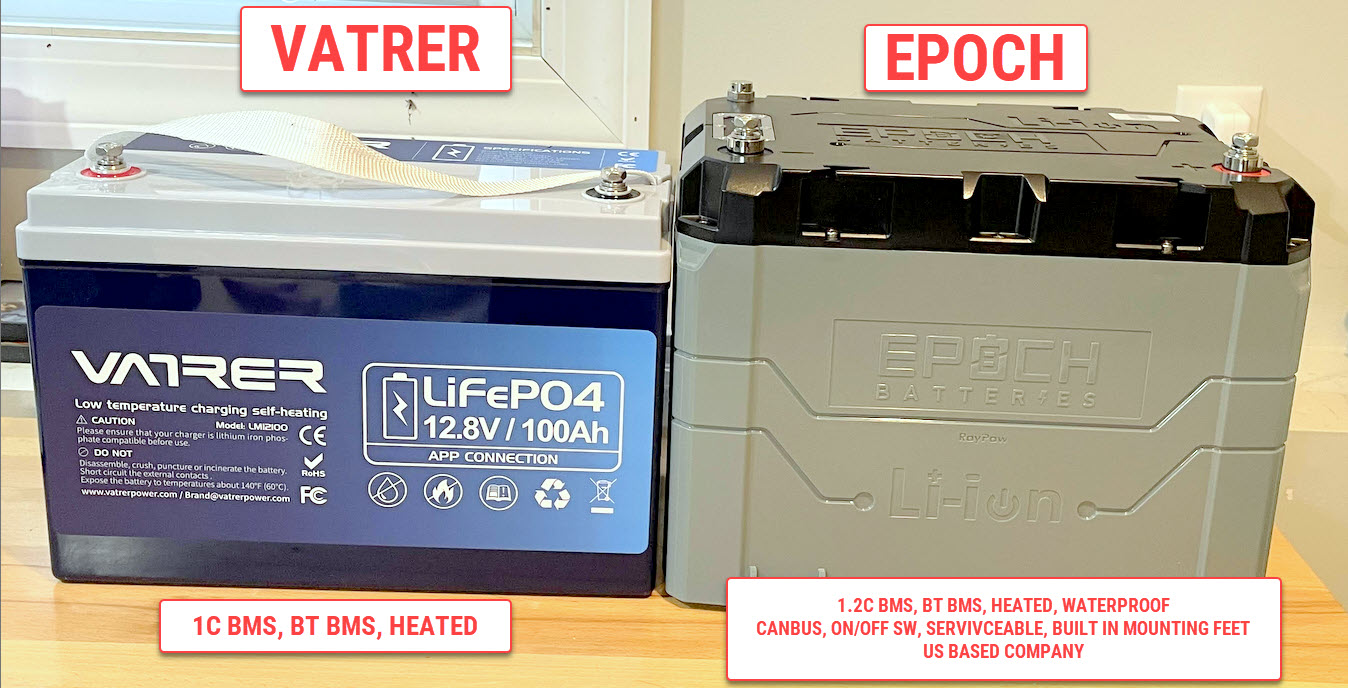
- 12V lithium house bank — powers everything aboard: lights, electronics, bilge pump, and the EP Carry kicker via the add'l 12V booster and cord I bought from EP Carry. The booster steps up to 24V with what I figure is 90% efficiency, which is acceptable to me in this use case. No loss of propulsive power per EP Carry (Could also use 36V).
- 24V lithium dinghy battery — dedicated to the dinghy when using the EP Carry on it (no booster required; native 24, have cord from EP Carry for this, too). Leaves the boat every time the dinghy does, plugs back in on return to recharge (or just taken into my house and plugged in). Could be used as backup for the CDory (kicker, batteries). Can use this to solar-charge the house bank down the road, too.
Charging:
- Alternator → intermediary to not fry alternator or lithium (TBD, if possible: external regulator?) → 12V lithium house bank. The BF90 dedicates approximately 30A to charging with the remainder powering the motor itself (44 total, IIRC)
- 12V house bank → small DC-DC charger → lead acid starter. Occasional top-up as needed, or trickle at home
- 12V house bank → eg Sol Buck Boost MPPT (recommended by EP Carry)→ 24V dinghy battery on return. Either the 10A cigarette plug version for simplicity, or the 20A hardwired version for faster charging.
Weight wise, I'm going from a 55lb Suzuki 6hp (excluding gas) to a 14lb EP Carry, so with cord call it 15, so net savings of 30lbs before battery. A 100Ah 12V lithium is around 25lbs quick math, so I'd only be saving 5 pounds overall with that, plus the loss of the house battery presently there, probably 35+ pounds, so call it a 40 pounds net savings off the stern. I'd then add a 6-15lb dinghy battery (TBD), call it 10lbs, so 30lbs net savings off the stern. Not a whole lot with these estimates, but it might be more in real life. But, I gain a lot more amp hours on the house battery and the ability to run the EP Carry all the time and have it charge by the Honda. My battery switch is broken anyway (can't turn it without pliers; seller gave me a set) so I need to mess around back there anyways, and update the electronics. So this is all a big improvement, but not a conversion or build-out. I just would like a second set of eyes to say "yep that would work fine" or "don't mix chemistries even with a DC/DC / forget a shunt / balancer / BMS" etc or you'll catch on fire etc.. I'm learning, but keenly aware I don't know what I don't know.
Thanks, All.
Last edited:
 well, once I recognized there’s nothing like it on the market, noise or otherwise, as well suited for what I wanted to do, and that I’d be “stuck” with a 4stroke as backup without it, I knew I had to act fast. Plus, they sell out each spring and I didn’t want to miss out. I spent way too much time trying to find a more elegant solution, but couldn’t. If it works as reviewed and described, I might try and sell the darn things in RI as a side hustle, ha