Our favorite cruising mods, 2026

Gulfcoast John

Active member
Joined
Dec 14, 2012
Messages
1,169
Reaction score
23
C Dory Year
2010
C Dory Model
255 Tomcat
Vessel Name
CAT 'O MINE
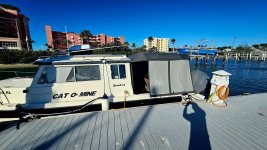
The 15K BTU Coleman AC croaked because I never cleaned the coils, which required removing the radar mast, dome, hailer, anchor light and pole plus wiring. We replaced it with a Dometic which is lighter (65 vs 100#) and a Dometic Soft Start module designed specifically for that compressor, which makes load management easier.

I’m leaving radar off because the next Adventure is back up to do the Triangle Loop into Canada. That requires a under 8 foot air draft to cruise the historic Lachine Canal right through downtown Montreal, rather than the awful Seaway Locks. Thanks to Pat Clause for that tip so many years ago. I like to think I helped convince at least six C-Dory crew to try that alternative over the past three years. And we can do it counterclockwise despite the 8 MPH current at Montreal, which the trawlers can’t fight. That allows doing both the Triangle Loop (Albany to Lake Champlain, take a left at Sorel onto the St L to Montreal, to Ottawa and come out at Kingston on Lake Ontario. From there you’re only 70 miles from the start of the Trent-Severn to Georgian Bay to Lake Michigan). For many cruisers the best parts are those Canadian segments.

our 10 yr loop.jpg


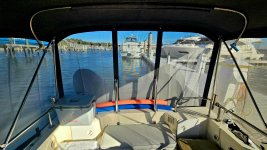
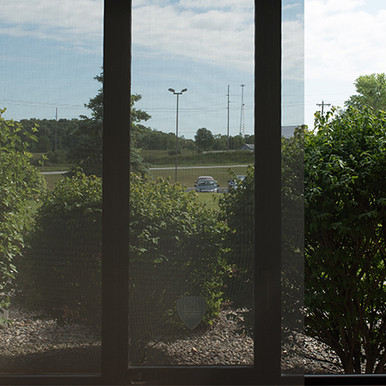
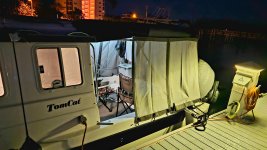
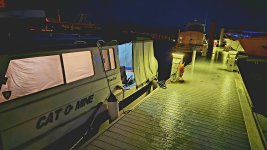
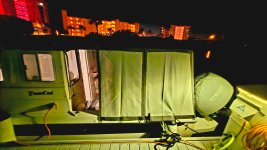
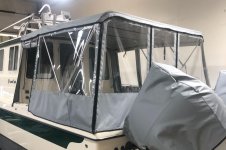
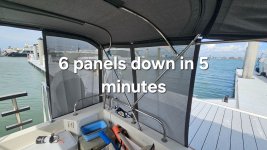
We still advocate our all-Phifertex 9 panel camper back for total privacy without clear vinyl while allowing ventilation.
20260224_084420.jpg20260224_084510.jpg

Folks over 70 (us) who are admitted after a fall have a 70% chance of being dead in 12 months. DON'T FALL! I added grab rails over the aft, galley, and fridge cabinets (doubles as a grab rail for Eileen in rough seas). Outside, over the cabin door and over both deck fills. Bolt those over the overhang, not through the roof. Deckadence carpet is better in a fall than teak/other hard surfaces. We wash both sections in a commercial washer with Clorox and hot water. Bob has described less expensive alternatives.

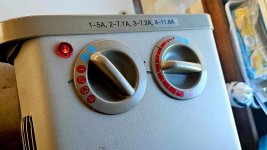
Ditto Bob, get a Kill-O-watt to measure the amp draw for every 110v appliance, and label each for easier load management. You only have 30 amps to play with.
20260224_084921.jpg

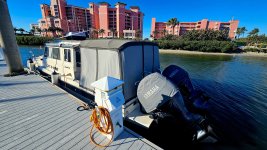
A SmartPlug shore power inlet conversion is much better designed and safer than the 70 year old standard twist lock design. Per code, boat wiring must be tinned stranded wire. The orange SmartPlug cable is the only one that meets that standard (and expensive). An inlet thermostat shuts off power if it overheats.

https://smartplug.com/ smartplug cable.jpg
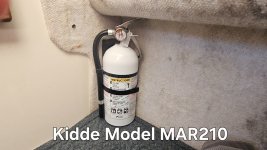
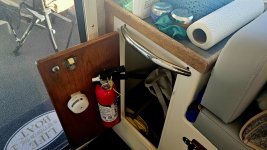
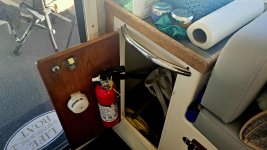
We added a 10yr smoke detector and fire extinguisher to the door inside the shore power inlet cabinet, which is where our fire started before we switched. You can reach an (added) grab handle from anywhere on the cabin floor. The Kidde Model 210 holds 4# (vs 2.5#) if you fit it in. MFGR date is stamped on the bottom. It's good practice to weigh and record each season, tip it (so chemicals don't get caked), and replace it every 12 years or sooner.
20260224_084218 - Copy.jpgkidde 210.jpg

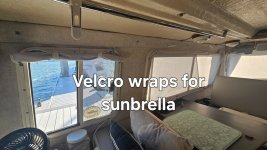
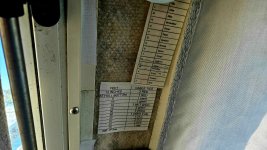
Although there are much more elegant choices, we like Velcro wrapping tape to hold up the sunbrella window coverings, which are washable and last 10 years or more. 20260224_084529 - Copy.jpg
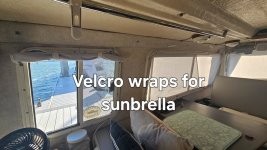

We like a 3inch closed cell foam topper for the berth and replace it every 3 seasons. There's plenty of room to add clear plastic stackable containers (with lables).
This continuous-on LED clock runs for a year on four AA batteries (longer if you take them out between Adventures).

This 10 year berth CO detector also shows the temperature when you press the bar (we like 62 degrees).

We're very glad we chose to repower with the same (Yamaha F150's with Helmsman EX Group 2...no AP or joystick. If you choose the AP, it's all 100% made and warranted by Yamaha so you don't have different makers pointing fingers at each other for each component in an autopilot.

We like to Velcro cards at the helm for the phonetic alphabet, anchor rode color tie marker depth tags, MMSI and Registration numbers, Sea TowTow Boat US, insurance and the Red-Green Popsicle Stick Nav Aid reminder (it really does help). helm cards 1.jpghelm cards 2.jpg
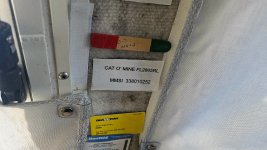
We spent ten years resisting replacing the blackwater system with an Airhead until we did last year. Now we'd never go back! Absolutely zero smell, ever and no more pump outs ever again!

More to come on days it's too cold to be at the pool.
John
 

Attachments

  • 20260224_084218.jpg
    20260224_084218.jpg
    1.7 MB · Views: 21
  • 20260224_084529.jpg
    20260224_084529.jpg
    1.4 MB · Views: 20
Question regarding your Phifertex panels, if you’d be so kind: I looked at some photos of inside vs outside, but they were during the daytime. In our home we have linen sheer drapes to block sunlight in certain rooms, which makes it almost impossible to see inside from outside while only minimally reducing visibility to the outside. However at night time, when the light source is on the interior, it flips and we cannot see out but everyone out can see inside with great clarity. Do those panels work similarly? If you’re at a marina in the cockpit, all zipped up with a light on, unable to see out, does everyone around you have a clear shot in, like the sheer linens?

Thank you!
 
Question regarding your Phifertex panels, if you’d be so kind: I looked at some photos of inside vs outside, but they were during the daytime. In our home we have linen sheer drapes to block sunlight in certain rooms, which makes it almost impossible to see inside from outside while only minimally reducing visibility to the outside. However at night time, when the light source is on the interior, it flips and we cannot see out but everyone out can see inside with great clarity. Do those panels work similarly? If you’re at a marina in the cockpit, all zipped up with a light on, unable to see out, does everyone around you have a clear shot in, like the sheer linens?

Thank you!
I found this page with an embedded window showing day/night on Phifertex Plus (92.5% shade vs 70% for regular Phifertex), so can take some guesses as to the 70%. Pros and Cons for blow-through ventilation and the ability to tight-roll-- and I certainly understand the appeal.

 
Excellent post; Thank you John.
I wonder about the outside person being able to see inside the Phifertex plus at night when it is dark outside and you have a light on in the cockpit? Do you have a cloth or some blocking material in case this happens?

The alternate to the DECKadence carpet is viny spegitti poll mat from American Floor Mats. The major difference, is the DECKadence seems to be a less stiff or pliabe material (softer), and the backing is like silicon floor 'non skid' mat. I have used the Deckadence in the cockpit, since it comes in wider widths. I used the vinyl pool mat below decks.

I have put an extra 18" long hand hold on both sides of the cabin house and on the front eyebrow, right at the turn to athwarts ships, on most of the C Dorys I have owned. Always, "one hand for the ship, and one hand for yourself". Below decks, there is a cheaper and effective way to add overhead hand holds on both sides of the cabin: I used SS clips which went around 1/2" back 3 strand Dacron line with a short eye splice on each end, and the tight support in the middle. The clips were put under the nut and over the bolt which holds the cabin SS railing which is just outside of the "hat" of the raised part of the Cabin House. (Sorry, my most of my photos are being held hostage by the old C Brat web site.) I 'll see if I can find them when I have more time.

John makes an excellent point--I have had several "less cordination" evens in my my to late 80's years of age. One sustained a bad solft tissue injury in my leg, the I hit my head on solid concrete (not C Dory related) and ended up with a subdural hematoma. I went to the ER, and was followed by a neuro surgeon until the blood clot on the outside of the brain resolved--which took several months. Subdural hematomas can be fatal, and falls often lead to premature deaths.
 
Question regarding your Phifertex panels, if you’d be so kind: I looked at some photos of inside vs outside, but they were during the daytime. In our home we have linen sheer drapes to block sunlight in certain rooms, which makes it almost impossible to see inside from outside while only minimally reducing visibility to the outside. However at night time, when the light source is on the interior, it flips and we cannot see out but everyone out can see inside with great clarity. Do those panels work similarly? If you’re at a marina in the cockpit, all zipped up with a light on, unable to see out, does everyone around you have a clear shot in, like the sheer linens?

Thank you!
Hi Dave, thanks for your interest.
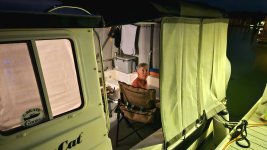
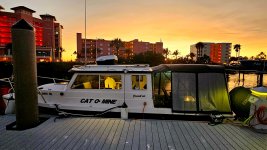
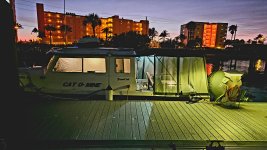
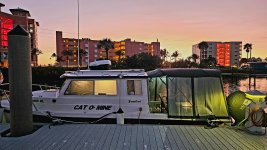
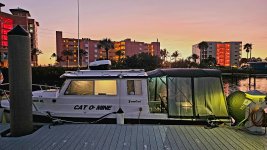
I took these pics last night. The cockpit lights are very bright, in fact they are Perko 'steaming' lights with the required 2 NM USCG visibility. We don't need more than a 3D cell Streamlight lantern in the dark. We use Kindles and tablets mostly. I bet you can see in the pics that Eileen has excellent privacy even with the bright cockpit lights on. Tap the thumbnails to enlarge. Marina lighting has code standards and tends to be bright enough to reflect off the enclosure. I think we chose the 90% version and I don't recall the cost. Hope this is helpful.
John
 
Hi Dave, thanks for your interest.
I took these pics last night. The cockpit lights are very bright, in fact they are Perko 'steaming' lights with the required 2 NM USCG visibility. We don't need more than a 3D cell Streamlight lantern in the dark. We use Kindles and tablets mostly. I bet you can see in the pics that Eileen has excellent privacy even with the bright cockpit lights on. Tap the thumbnails to enlarge. Marina lighting has code standards and tends to be bright enough to reflect off the enclosure. I think we chose the 90% version and I don't recall the cost. Hope this is helpful.
John
20260226_061002.jpg20260226_060948.jpg20260225_192009.jpg20260225_191958.jpg20260226_061002.jpg20260225_184254.jpg20260225_190036.jpg20260225_191958.jpg20260225_192009.jpg20260226_060948.jpg20260226_061002.jpg
 

Attachments

  • 20260225_184811 (1).jpg
    20260225_184811 (1).jpg
    2 MB · Views: 17
  • 20260225_184811.jpg
    20260225_184811.jpg
    2 MB · Views: 14
Excellent post; Thank you John.
I wonder about the outside person being able to see inside the Phifertex plus at night when it is dark outside and you have a light on in the cockpit? Do you have a cloth or some blocking material in case this happens?

The alternate to the DECKadence carpet is viny spegitti poll mat from American Floor Mats. The major difference, is the DECKadence seems to be a less stiff or pliabe material (softer), and the backing is like silicon floor 'non skid' mat. I have used the Deckadence in the cockpit, since it comes in wider widths. I used the vinyl pool mat below decks.

I have put an extra 18" long hand hold on both sides of the cabin house and on the front eyebrow, right at the turn to athwarts ships, on most of the C Dorys I have owned. Always, "one hand for the ship, and one hand for yourself". Below decks, there is a cheaper and effective way to add overhead hand holds on both sides of the cabin: I used SS clips which went around 1/2" back 3 strand Dacron line with a short eye splice on each end, and the tight support in the middle. The clips were put under the nut and over the bolt which holds the cabin SS railing which is just outside of the "hat" of the raised part of the Cabin House. (Sorry, my most of my photos are being held hostage by the old C Brat web site.) I 'll see if I can find them when I have more time.

John makes an excellent point--I have had several "less cordination" evens in my my to late 80's years of age. One sustained a bad solft tissue injury in my leg, the I hit my head on solid concrete (not C Dory related) and ended up with a subdural hematoma. I went to the ER, and was followed by a neuro surgeon until the blood clot on the outside of the brain resolved--which took several months. Subdural hematomas can be fatal, and falls often lead to preFWmature deaths.
Thanks Bob and also for all we've learned from you over the years! I hope the night photos show we never have a night time privacy concern and don't need 'blocking' material. We'd likely use LED headlamps if reading a paper book and never have, say, two 100w lamps at night in the cockpit. I tend to position the egress point close to the power pedestal light/water since we don't drink the FW tank water. 12 years ago I forgot to screw on the FW tank cap after filling. The next morning Eileen said "Gross! What if a rat crawled in there last night and died! I'll never drink from that tank again!"
And she's kept her word on that. We refill Publix water jugs for up to two weeks then buy new ones.
Cheers!
John
 
Thank you, John, for both doing this and for sharing with the forum for all who come after. I know what you mean about not usually having lots of bright lights on, and appreciate this stress test. I also appreciated your encouraging hose tests from before. I'm taking notes to have an enclosure made this spring (hopefully, TBD on how far out they book) and keep flip-flopping between something like yours and something like Bob's old one on his Tomcat with the solid side curtains and small windows (either up or down, pick one).

I'm less motivated by aesthetics on this, just "fear" that the privacy wouldn't be there and that things would get wet. With my little ones aboard (and it's only a 22) we intend to use the cockpit as a functional room and don't want stuff getting even a little bit wet (any more than just the "dampness" that can occur camping). Is it really that water tight? Or is a situation were we should just plan for some backup belt/suspenders and have a second set of curtains inside (taking me back to the "either up or down" approach, plus netting).

Appreciate very much your experience-driven suggestions (I think I recall your saying this was the best after like 13 trailer boats).
 
It is difficult for me to believe that there is not some water influex into the cockpit through John's Phifertex panels in heavy rain and wind--certainly conditions we have encountered in all areas of the US in our cruising C Dorys and larger boats. There certainly is visability through John's Phifertex panels in his photos.

You cannot go wrong with insect screen and zip out/up Sunbrella/clear vinly panels or similar. It works--no questions. We were cruising with about 4 other c Dory at Chatangonuga during some heavy rain. Our cockpit was the only one with no water intrusion. For privacy in the cockpit, we used light weight opaque cloth panels where necessary to block the view from outsiders thru the clear vinyl panels. For your use with the kids, I would go with conventional camper back materials.

By the way, we have used tank water for all of our drinking in the USA--We use watermaker water from a tank outside the US. We do carry a boat 6 gallon can for transporting water, and in case we get a bad batch of water.
 
I have a standard enclosure and it does keep my cockpit very dry, enough that I have slept in there while it rain all night. I do have a good amount of water that pool in the back, between the last and second support and have recently develop small drip when that happen for a long time (like overnight) with little boat movement. I’m hoping that treating the canvas and tighten things up to reduce the sag will help. I also have panel that velcro on the inside for privacy, but since I anchor most night that I’m out, I don’t use them much. As for the size of the windows, I wouldn’t want them any smaller as my personal choice. The enclosure top is even with the trailing edge of the cabin roof, I would much prefer if it raise up like on thataway and Cat 'O Mine for extra head room.

DaveInRi, hope those few comment help a bit in the planning for your enclosure.

8977706_20230730134640241_1_XLARGE.jpg
 
Wind-driven rain gets in, so if you want a dry cabin extension one like Bob's is better. Having nine panels of BOTH materials to choose from would be really elegant.
Happy Hunting,
John
 
"Having nine panels of BOTH materials to choose from would be really elegant.
Happy Hunting"

I am not sure where John came up with 9 panels. The opaque material is light weight, and in a single sheet for each side. The can be hung with snaps, lift the dot fasteners or Velcro. On out last 25 all of the camper canvas stowed in the "hightop". A previous owner had put slats across under the cabin top inside even with both sides, which gave a huge storage area: We had the Camper Back sides and all other materials for it, plus the life jackets up there and out of the way. If we had a roof air conditioner, it would have in a space forward between the electronics shelf and where the stowage area started. As it was we prefered to keep the raised top clean to allow easy storage of the 9 1/2 foot air floor inflatable, and all of the electronics antennas on the Radar Arch which was high enough for the inflatable to slip under it in the center, and 2 large fenders on each side to be outboard of the "hi top" and the arch. Clean top. The window AC was kept under the bunk, as a portipotty would be stowed in a C Dory22. The 5000 BTU window unit was plenty to cool the 25's interior even in over 100 degree weather and would run on a 1000 Watt Honda Generator, as would a 700 watt micro wave and 600 watt induction burner. This would keep the interior cool. The windows all had had the Bubble Wrap, Reflextic mylar material between the curtains and the windows. These are big heat sinks, unless insulated to some degree.

The Tom Cat camper back had very small windows, but the entire back was clear vinyl.. It was an experiment in the way we used the boat. All of our other boats had the more conventional camper back screen with zip out clear vinyl windows. Remember there are many different grades of clear vinly. They run for cheap several mill thickness to heavy window glass clarity, which should only be rolled with light old muslin sheets inbetween the layers to avoid any scratching.
 
Panels are easy to remove quickly, take a bit longer to install when aligning the zippers on the sides and top with Sai-panels.jpglrite bungeys at the bottom.
 
These are the ‘gadget’ adapters shown at the Hontoon Hoot. You will eventually happen on a marina or wall which only has a 50 amp pedestal available. The adapter you need is a 50A 125/250V to 30A 125V (not 50A 125V, which would only be found in very old marinas). Be sure the marina agrees to charge you the 30 amp rate. Many will rent you one for $10/day, but even at $100 mine has paid for itself many times over. This is the cheapest one I’ve ever found but note it is not UL approved.

https://www.amazon.com/CircleRiver-Adap ... NN79R&th=1

I use this one:

https://www.ebay.com/itm/253525743818?m ... 899b0f632fk

50 amp Adapter for 30 amp boat inlet:
You need 50 amp side marked “SS2-50P”, which has 2 not 1 main pins with an “L” bend (and an additional ground plate). If the marina pedestal 30A outlet is blackened from arc marks, or won’t take the twist or your plug keeps falling out, use the 50A adapter instead. If your boat attempts to suck more than 30A from your pedestal, your AC distribution panel 30A breaker will trip. It meets code, no worries.
Credit to Bob Austin.
 
Our new interest in a lithium + big inverter option when shore power is not available:
We hope to be spending time on the Canadian walls this summer while doing the Triangle Loop backwards; ending up at Kingston on the North side of Lake Ontario and only 70 miles to the entrance of the Trent-Severn at Trenton, which ends up in Georgian Bay. I don’t want to take the Honda 2000 or use our propane appliance options due to proximity to other boats (noise), CO risks, and we get up at dawn. I don’t want a lithium ‘drop-in’ replacement house battery because there is no such thing, and if there were I couldn’t Combine it with an engine start battery (all new group 31 AGM) when needed. I don’t want to replace the high quality Blue Seas PS40 non-lithium battery charger, which has the unique feature of placing each of three AGM batteries into pre-float mode (esp the house battery).

Jim Healy seems to be the senior electrical guru on the AGLCA forum (members only) but he offered this link to his personal website. Skip down if you want to ‘Just what is a Power Station’ as well as the ‘Grounded Neutral’ section. I am a ‘Electrical Non-Techie’ and if I understand it, whenever you are not on shore power and feeding the output of either a Honda type generator OR a power station into your boat AC panel (both power station and Honda have a floating ground), then you place the ‘cheater pug’ in any 110v outlet on either the Power Station or the Honda to avoid possible Reverse Polarity alarms or loss of protection on GFI outlets. Is that right?

I would wire the shore power into the Pecron ‘dryer’ adapter for charging and the Pecron AC outlet to the AC distribution panel when at anchor or on a wall without hydro with the cheater plug inserted (removing it when on shore power). Very appealing design to me; I’d add one extension battery and use the AC panel branch circuit breakers for load management. When shore AC is present (pull the cheater plug) the power station passes it through to the boat AC panel, when AC is not present, the Pecron provides it to the panel and the boat doesn’t know it’s not shore power.

https://gilwellbear.wordpress.com/c...-topics/alternative-way-to-implement-lithium/

It’s heavier than the Honda but I picture a semi-permanent install with no gasoline, noise, CO, propane or open flame issues, plus the advantage of two separate 12V systems and the huge advantage of no concern for the night time draw of the fridge. The Pecron would handle that. I’m not sure whether it’s more efficient running on converted 110AC or 12V DC, but with 3600 watts x 2 I may not need to care. Our 100w solar panel won't fully replace the fridge night use on a cloudy day in northern latitudes. Comments welcome!
 
I appreciate the draw of an "all in one unit". There are now several dozen various "suitcase power supplies". or Solar Generators, which is the suitcase (batteries, fuses ?? monitoring, and inverter in one piece.). Pecron, Jackery, Oupes, etc. I much perfer to use the equiptment which I know is high quality and well proven on my boats--I then know how to monitor the use of power, how much fuse there is, to avoid overloads etc. My choice was a separate bank of two 100 amp hour LiFePO4 batteries, a 2000 WATT Victron Multiplus pure sine wave inverter, with integral 80 amp charger and 50 amp voltage/amperage boost-(Many marinas do not have the highest quality wiring, and it is not too unusual to have 90 volts at the end of the gangway--The Victron will boost that to 120 volts so you don't fry your appliances. (or yourself). We ran induciton burner, microwave and two chest freezer/refers off our system. The Honda 150 would charge the LiFePO4 batteries at 30 amps thru a battery to battery charger. I have designed and built a 600 amp battery bank, 1200 watt solar system, with a 3000 watt PSW inverter to power our home appliances in case we loose fuel for our usual back up electrical power.

John, where you loose me is use of the word "Pecron"--which apparently is a Chinese company headquartered in Shenzhen China. They make all sorts of electrical items, and to my knowledge is fairly new on the American scene. I do find plenty of references to it on some of the "solar" forums. Amazon seems to be carrying other products (Circle River) as a cheap alternative to Marinco, which is the standard, and because I don't want a fire on my boat, I use, and check the connections every few weeks. The "Pecron" appears to be like any of the "all in one" suitcase units, which has some form of battery, a charger for that battery off 120 volts main power, and an inverter to the rated capacity of the unit.

The cost of LiFePO4 batteries, has come down, and there are well reviewed batteries by Will Prowse, for several hundred dollars, equal to $1000 batteries I put into my C Dory 25 seven or so years ago. I personally prefer to use Victron or Mastervolt--non Chinese companies, with better American Support, where you can talk directly to the engineers who designed the circuits and devices.

Is this "Pecron" a marine quality unit, and UL certified to use on a boat or in a marine environment? How Corrosion resistant is this? How good is the monitoring? Again, I understant the "non Techi"--but I do believe we all need to understand exactly what is going on in our great little boats, so we don't make a mistake.

By the way, I would be frightened by the neutral to ground and if some one forgot to remove the plug between neutral and ground---if the neutral becomes "hot"---as it is all too often in marinas which had not modernized, or tested all of their circuits (and this includes a boat "next door" which is wired improperly--and is putting power to the neutral circuit at his shorepower or some appliance level--happens all to often-that then puts you at risk. Using this "adaptor" is illegal in many jurisdictions, including all of Canada--and creates a danger to anyone in the water near your boat. Sorry, but anyone who advised this is not an expert in anything--he is creating a lethal danger!

I doubt that your LP gas units would creat a CO threat for neighbors---some generators can however. I would not run any heater off LP anyway. We had a 4 burner range with oven on both our 62' Ketch and the Cal 46, and never had any reservations using these appliances, even when rafted 6 deep in Horta, Azores. Used them hundreds of times when next to sea walls, and never an issue.
 
Back
Top